Category: Yapping with Tyler

  • William L. Kemp: A Confederate Soldier Remembered in New York

    William L. Kemp: A Confederate Soldier Remembered in New York

    A Mystery in New York

    At first glance, a Confederate soldier buried in New York might seem like a mistake or at least a mystery. But that’s exactly what makes the story of William L. Kemp so compelling. Born in Virginia, a veteran of the Civil War, and eventually laid to rest far from the fields he once fought for, Kemp’s life tells a quiet but fascinating story of service, survival, and unexpected turns.


    Early Life in York County

    William L. Kemp was born on February 6, 1824, in York County, Virginia. This coastal region of southeastern Virginia was home to farmers, tradesmen, and working-class families. While little is documented about Kemp’s youth, we know he married Eliza Frances Dyer in 1846 in Richmond, Virginia. This is a sad tale that happened to many people in this time period. They would have several children and spend the next decade building a life. That life would soon be disrupted by war.


    Service in the Civil War

    When the Civil War broke out, Kemp joined the Confederate ranks, enlisting as a Private in Company C, 10th Battalion Virginia Heavy Artillery, also known as Allen’s Battalion.

    This wasn’t just any unit. The 10th VA Heavy Artillery was assigned to defend key points around Richmond and coastal Virginia. These were the men behind the big guns, responsible for manning fixed fortifications, guarding the capital of the Confederacy, and eventually converting to infantry roles as manpower dwindled.

    In 1864, the unit helped repel Union forces at Drewry’s Bluff, one of the critical defenses south of Richmond. As the war neared its bitter end, the 10th was absorbed into the infantry and joined Lee’s Army of Northern Virginia. Kemp’s unit fought in the final campaigns leading up to the Confederate surrender at Appomattox in April 1865.

    Kemp survived the war. There’s no record of him being wounded or promoted, but his continued presence in unit rosters tells us one thing, he endured and he survived through some of the worst.


    A New Life Up North

    After the war, Kemp didn’t stay in Virginia forever. He and Eliza eventually relocated to Patchogue, New York, on Long Island. We don’t know exactly when the move happened, but census and family records suggest it was sometime in the 1870’s.

    Why New York? It could have been for work, family, or simply the fresh start many former Confederates sought after the South’s defeat. Whatever the reason, he lived out his final years there and passed away on May 14, 1880, at the age of 56.


    Remembered by His Family

    Kemp’s wife, Eliza Frances Kemp, survived him by more than three decades. She lived in Patchogue until her death in 1912. Interestingly, she applied for and received a Confederate widow’s pension from the state of Virginia in 1906, long after they had left the South. This confirms just how real and enduring their ties to the war remained.


    A Grave Far from Home

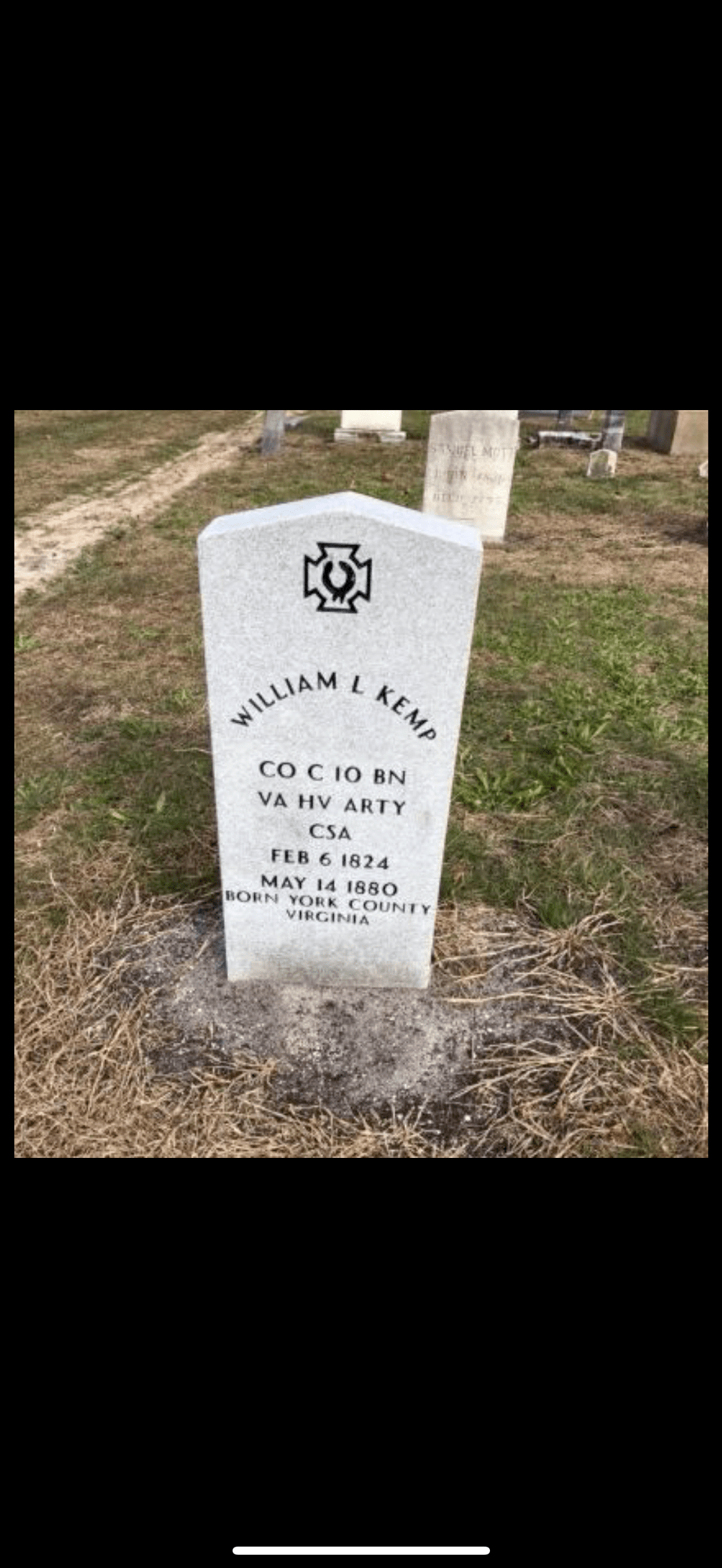
    Today, William L. Kemp is buried in Lakeview Cemetery in Patchogue, NY, beneath a Confederate veteran’s marker. The gravestone, which includes the Southern Cross of Honor, recognizes his service with Company C of the 10th Virginia Heavy Artillery. It’s a quiet but striking reminder that the war’s legacy reached far beyond the Mason-Dixon line.


    Legacy

    William L. Kemp like tens of thousands of others, he was there. He served. He survived. He rebuilt. And thanks to the records, markers, and memories preserved by his family, his story still matters.

    Sometimes history isn’t about the biggest names. It’s about the real people who carried the weight of their time, people like William L. Kemp.


    Got ancestors with similar stories? Drop them in the comments or shoot me a message this page is all about telling the forgotten stories of the Civil War.

  • The Forgotten Sergeant: Adolph Olivia of the 95th New York

    The Forgotten Sergeant: Adolph Olivia of the 95th New York

    I wasn’t planning on uncovering a piece of Civil War history that day.

    I had taken one of my dogs to the vet just for a routine visit. While I waited, I remembered hearing there was a really old cemetery nearby. I had a little time to kill, so I figured I’d check it out. Don’t worry my dog did not leave the car and I was right next to the car while it was blasting the AC before anyone comes after me! Back to the story…. I expected a few moss-covered stones, maybe a Revolutionary War-era grave or two. What I didn’t expect was to stumble across the resting place of a Union Army sergeant.

    “Adolph Olivia, Sergeant, Co. G, 95th Reg’t N.Y.V., Died March 1888.”

    The stone stood tall and sharp one of those beautiful zinc “White Bronze” markers. I assume this was a replacement headstone, but I snapped a photo and went home wondering: Who was this man? What was his story? How can I give this man the honor he deserves?

    Turns out, it was a story worth telling.

    From Paris to the Potomac

    Adolph Olivia was born Adolphe Antoine Olivie in 1842 in Paris, France. Like many immigrants in the 19th century, he crossed the Atlantic in search of something better and settled in New York. In November 1861, with the Civil War raging, Olivia enlisted in Company G of the 95th New York Volunteer Infantry also known as the Warren Rifles.

    And he didn’t enlist as a private. He mustered in directly as a Sergeant which was rare for new recruits. Whether due to prior experience or pure leadership potential, Olivia was given immediate responsibility.

    Baptism by Fire

    The 95th New York trained through the winter of 1861–1862 and headed to Washington, D.C., by spring. They were first assigned to the defenses of the capital but quickly joined the fighting in Virginia.

    Their first major engagement came at the Second Battle of Bull Run in August 1862, where the 95th suffered heavy losses. 113 casualties in that campaign alone.

    The regiment regrouped in time for South Mountain and the bloodbath at Antietam in September 1862. It continued fighting at Fredericksburg in December, although it was held in reserve and avoided the worst of that Union disaster.

    By the end of the year, Olivia had seen serious combat and likely, serious trauma. It’s unclear whether he was wounded, sick, or both, but on January 13, 1863, he was discharged for disability while in Baltimore. His war was over. He had served just under 14 months.

    The Regiment Marches On

    Though Olivia returned home, the 95th kept fighting. They went on to fight at:

    Chancellorsville (1863) Gettysburg, where they suffered 115 casualties. The Wilderness, where they lost 174 men. Spotsylvania, Cold Harbor, and Petersburg as well.

    They were present for the final campaign and were at Appomattox Court House when Lee surrendered in April 1865.

    By war’s end, over 250 men of the 95th had died in battle or from disease. While Olivia wasn’t there for those later battles, he was one of the regiment’s original noncommissioned officers; part of the backbone that held it together in its formative days.

    A New Life in New York

    After the war, Adolph Olivia returned to civilian life. He married Emma Nichols, and they eventually had several children: Lillie, Jennie, Viola, and a son named William Adolph Olivia, born in 1880.

    In the 1870s, Olivia worked and lived in Manhattan before moving to Hauppauge, Long Island, in the 1880s. He remained active in veteran affairs in 1880, and he even signed a petition to Congress demanding fair bounty payments for Union soldiers.

    He was, by all accounts, a quiet but proud veteran who built a modest life after a brutal war.

    A Tragic End in a Historic Storm

    In March 1888, a massive snowstorm slammed into the Northeast. It became known as The Great Blizzard of 1888, and it paralyzed New York with wind, snow, and freezing temperatures.

    Adolph Olivia was caught in it.

    According to local accounts, he became disoriented in the blizzard, fell over a fence he couldn’t see, and was impaled on the pickets. He died of his injuries soon after; a brutal and unexpected end for a man who had survived war.

    He was around 46 years old.

    Legacy in Stone

    Olivia was buried in Hauppauge in a cemetery tucked just off the road; the one I visited by chance after taking my dog to the vet. His grave is marked with a zinc White Bronze headstone, etched with his name, unit, and the year he died.

    He didn’t die in battle. He didn’t become a general. But he served, he came home, and he lived a full life after the war. And in that quiet cemetery, with no fanfare, he’s still remembered thanks to a well-preserved grave and a story that now gets to be told again. From one NCO to another, thank you for your service, Sergeant.

    Sources

    New York State Military Museum: 95th New York Infantry History

    New York Civil War Muster Roll Abstracts Adolphe A. Olivie Find A Grave: Sgt. Adolphe Antoine Olivie

    46th Congress U.S. Senate Documents, 1880 – Equalization of Bounties

    Historical summaries of the Great Blizzard of 1888 95th NY Roster (Company G), compiled records

  • How the Hell Did Braxton Bragg End Up in Charge?

    How the Hell Did Braxton Bragg End Up in Charge?


    You ever read about a Civil War battle, see the name Bragg, and just let out a sigh? Same. I’ve probably done it a hundred times now. The dude lives rent free in my head, unibrow and all. But back to the real conversation. Thinking of Chickamauga? Sigh. Perryville? Sigh. The man seemed to pop up everywhere you didn’t want him.

    But here’s the thing I keep coming back to: how did Braxton Bragg keep ending up in command when everybody hated him and he was objectively awful at the job?

    I was reading about this recently and it makes more sense now that I take it into context. Mind you, this wasn’t just hindsight. People at the time thought he sucked. Honestly just about everyone thought this (minus one very important person who we will come back to). His officers hated him. His men hated him. Even his own horse probably hated him. I don’t know anything about his horse but you get the point.

    And yet… there he was. Over and over again. In charge.


    The Resume of a Disaster

    Bragg had a decent early military record you could argue. Mexican-American War vet. Artillery guy. Got some praise for discipline and logistics. But once the Civil War kicked off and he was given real command responsibility? It all went downhill fast. Some leaders work better with smaller unit sizes. You might think of someone like Burnside who did well in Carolina, but did not do so well in Fredericksburg or Petersburg. But I still can’t defend Bragg.

    Bragg argued constantly with subordinates, made half-baked strategic decisions, and couldn’t hold onto a win to save his life. Even when he won.

    Perryville? Tactical success, but he gave up the field. This drives me insane. Davis defended the tactical retreat too! Sorry, Bragg called it a tactical withdraw… Chickamauga? Legit Confederate victory but he let the Union keep Chattanooga because he didn’t follow through. We always talk about how much McClellan did the same thing, but the difference is Bragg was WINNING.


    The “Jeff Davis” Problem

    This is the heart of the issue: Jefferson Davis liked him. They were old friends from the pre-war army. Davis backed him no matter how many officers begged for Bragg’s removal.

    It’s like when your boss keeps promoting their college roommate. Meanwhile, the rest of the team is screaming into the void. Davis thought Bragg was “dependable” but dependable at what? Losing momentum?


    Morale? What is that?

    There are letters, reports, and diary entries that straight-up say: “We hate this guy.” William J. Hardee, Leonidas Polk, and others tried to oust him. At one point, half his corps commanders were actively working to get him fired.

    And the best part? Bragg would accuse them of being the problem. It was always someone else’s fault. Was Bragg an idiot, a narcissist or just naïve? If you read the book Company Aytch by Sam Watkins, you will understand Bragg from the average soldier’s perspective. Their feelings about Bragg were negative. Very negative. It is funny because as a solider in the US Army one of the biggest and most well-known bases is Fort Bragg. I think the unibrow convinced someone he needs a base named after him.

    Imagine being a soldier and realizing Bragg is in charge of your unit? Shameless plug for my reel that I made.


    Why Did He Stay?

    The answer isn’t satisfying, but it’s real it seems like Confederate leadership was built more on loyalty and politics than performance. Davis was loyal to his friends, even when it hurt the war effort. Bragg was familiar. Bragg was a friend. That counted for more than effectiveness.

    Better generals were out there. The press openly called for Bragg to go. But Davis refused until it was far too late.


    Final Thought

    The Civil War has no shortage of “what were they thinking?” moments. But Bragg’s continued command might just be the worst of them. He just wasn’t the guy for the job. And yet, there he was. Battle after battle.

    Sometimes I wonder how different the Western Theater might’ve looked if literally anyone else had been in charge. But if nothing else, Bragg gives us a perfect example of what not to do in leadership. Maybe West Point can teach what Bragg did so we can learn the opposite.