Category: Uncategorized

  • The Battle of Stones River: A Bloody New Year in Tennessee

    The Battle of Stones River: A Bloody New Year in Tennessee

    If you ever drive through Tennessee, it feels calm and ordinary. A mix of neighborhoods, trees, and quiet roads. It’s weird to think that those same fields were anything but peaceful. In the final days of 1862 and the start of 1863, a small town became the site of one of the most brutal battles of the Civil War, known as the Battle of Stones River.

    Setting the Stage

    By late 1862, things were tense for both the Union and the Confederacy. General William Rosecrans had just taken over the Union’s Army of the Cumberland, and General Braxton Bragg was leading the Confederate Army of Tennessee. Both men were confident, but both were under a ton of pressure from both their presidents, although maybe not Bragg because Davis loved him, but regardless. Rosecrans needed a clear victory to hold Nashville. Bragg wanted redemption after earlier losses and a chance to prove the South could still hit hard.

    They finally crossed paths outside Murfreesboro, a place divided by a cold, twisting river that soon ran red with blood.

    The Battle Begins

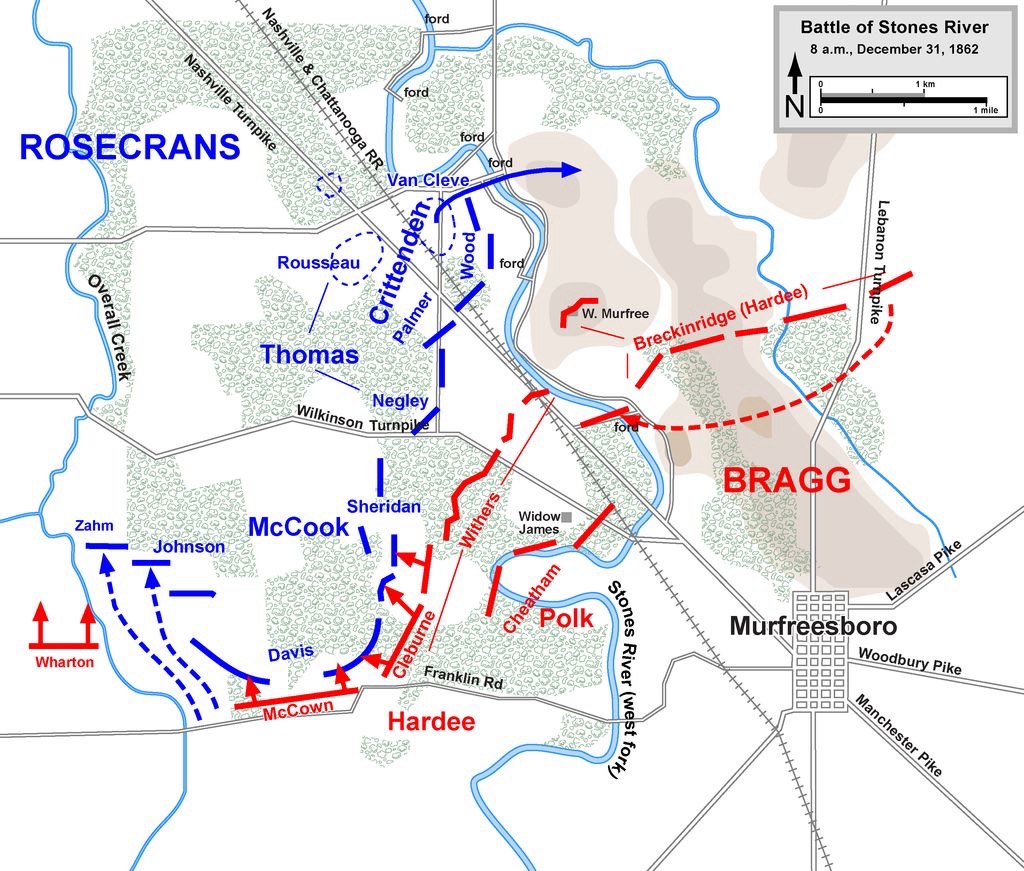
    On December 31, Bragg went on the attack. He hit the Union right flank as hard as he could, and for a few hours it looked like the Confederates might pull it off. Union troops were pushed back again and again, fighting tooth and nail just to hold their ground. The noise must have been unbearable gunfire, cannon blasts, and the screams of the wounded.

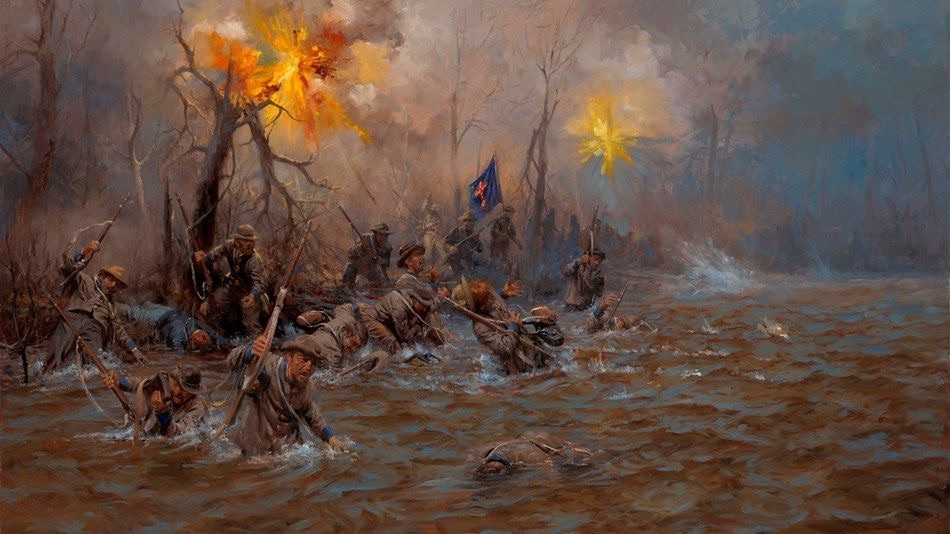
    Still, Rosecrans held firm. Covered in blood from a grazing wound, he rode along the front lines shouting orders and trying to keep his men from breaking. On January 2, the Confederates tried again, launching another attack across Stones River. It went horribly wrong. Union artillery tore them apart in minutes. Many of Bragg’s men were killed on the spot or swept away trying to retreat across the icy water.

    By January 3, Bragg had no choice but to fall back. The Union army stayed where it was. Technically, it was a victory but a very costly one.
    The Cost and Consequences

    Out of about 81,000 soldiers who fought, over 23,000 were killed, wounded, or missing. That’s almost one out of every three men. Lincoln, desperate for good news, called it one of the most important Union victories of the war. “God bless you and all with you,” he wrote to Rosecrans. It was a small boost in a very dark winter for the North.

    For the South, it was a painful loss. Tennessee had been a major stronghold, but after Stones River, the Union’s grip on the state only tightened. Bragg’s leadership was questioned, and his own officers started to turn against him. The cracks inside the Confederate command grew wider.
  • Today in Civil War History: The Battle of Peachtree Creek (July 20, 1864)

    Today in Civil War History: The Battle of Peachtree Creek (July 20, 1864)

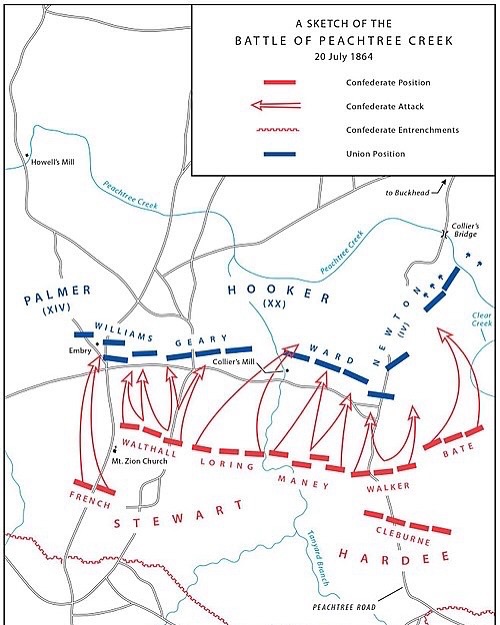
    Three days into his new job commanding the Confederate Army of Tennessee, Gen. John Bell Hood tried to stop the Union drive on Atlanta by going on offense. He struck Maj. Gen. George H. Thomas’s Army of the Cumberland as it crossed Peachtree Creek just north of the city. Bold idea. Bad timing. The Union line held, and Hood burned through men he could not spare. 

    Why Fight Here?

    After weeks of retreat under Gen. Joseph E. Johnston, Confederate forces fell back behind the Chattahoochee River the last major natural barrier before Atlanta. When Sherman forced a crossing in mid-July, his three Union armies fanned out: Thomas moved south toward Peachtree Creek; Schofield and McPherson angled east toward Decatur and the Georgia Railroad. Confederate leadership in Richmond lost patience with Johnston’s defensive withdrawals and replaced him with Hood on July 17, hoping for a stand-up fight to save the city. 

    Hood’s Plan

    Hood saw an opportunity: Thomas’s army was partly over the creek, partly not, and there were gaps between Sherman’s widely spaced columns. Hood ordered Lt. Gen. William J. Hardee and Gen. A. P. Stewart to attack in echelon on July 20 “everything on our side of the creek to be taken at all hazards” drive the Federals west toward the Chattahoochee, and smash Thomas before Schofield or McPherson could intervene. If it worked, Hood might cripple a third of Sherman’s total force. 

    What Went Wrong

    Morning developments forced Hood to shift his entire line right to confront unexpected Union pressure east of Atlanta, eating up precious hours. By the time Hardee and Stewart were realigned, roughly 90 minutes lost, the trailing elements of Thomas’s army had crossed Peachtree Creek and begun digging in on higher ground south of the stream. The Confederates attacked late and against troops no longer strung out. 

    The Fighting

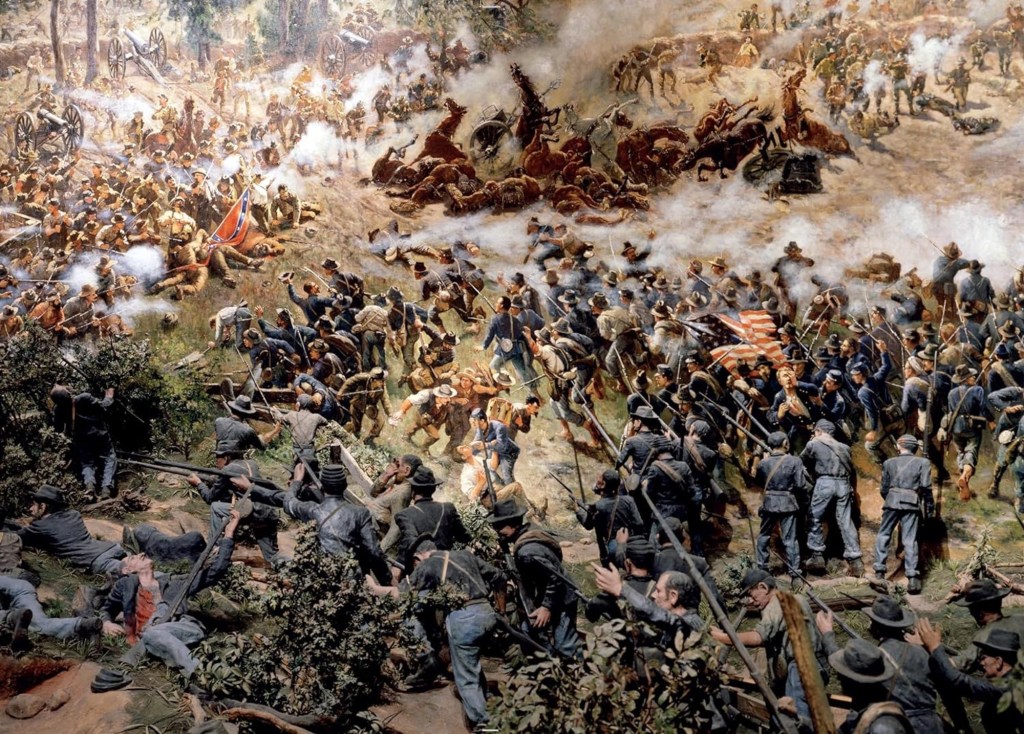
    Hardee opened (belatedly) around mid-afternoon. Parts of his lead divisions became disoriented in thick ground between the Union and Schofield sectors; others charged into prepared positions and were cut up by musketry and artillery. Stewart’s corps then went in, battering the Union XX Corps line: brief penetrations, local crises, but no sustained breakthrough. Union commanders refused flanks, plugged gaps, and counterfired with entrenched artillery. By early evening, the assaults had spent themselves and Confederate forces pulled back. The field belonged to Thomas. 

    Casualties: How Bad?

    Numbers vary by source (common with Civil War actions where fighting sprawled and reporting lagged). Modern summaries place Union losses roughly 1,700–1,700+ and Confederate losses from about 2,500 to nearly 4,800, depending on what’s counted (killed, wounded, missing) and whose reports you trust. The National Park Service gives US 1,710 / CS 4,796 (total ~6,506); the New Georgia Encyclopedia cites about 1,700 Union / 2,500 Confederate; other narratives put totals in the 4,000–6,500 range. However you slice it, the Confederates paid heavily for no operational gain. 

    Strategic Impact

    Peachtree Creek was Hood’s opening statement: he would attack, not hunker down. The problem he was outnumbered, facing a well-supplied, coordinated foe, and his army could not absorb repeated high-cost blows. Two days later he attacked again (the Battle of Atlanta, July 22) and was repulsed; still more assaults followed (e.g., Ezra Church). Each failure weakened the Confederate defense and tightened Sherman’s grip on the city, a campaign whose outcome would help secure Lincoln’s reelection and cripple Confederate hopes. 


    Sources

    1 American Battlefield Trust, Battle of Peachtree Creek, https://www.battlefields.org/learn/civil-war/battles/peach-tree-creek

    2 National Park Service, Battle Detail: Peachtree Creek (GA016), https://www.nps.gov/abpp/battles/ga016.htm

    3 New Georgia Encyclopedia, Atlanta Campaign, https://www.georgiaencyclopedia.org/articles/history-archaeology/atlanta-campaign/

    4 Kennedy Hickman, Battle of Peachtree Creek, ThoughtCo, https://www.thoughtco.com/american-civil-war-battle-of-peachtree-creek-2361042

    5 History.com Editors, Battle of Atlanta, https://www.history.com/topics/american-civil-war/battle-of-atlanta

    6 Eicher, David J. The Longest Night: A Military History of the Civil War. University of Illinois Press, 2001.

    7 McMurry, Richard M. John Bell Hood and the War for Southern Independence. University Press of Kentucky, 1982.

  • Time to Rethink This Blog

    I originally started this blog to expand on my Civil War Instagram posts. You know, longer versions of stuff I was already sharing. But honestly? It feels very redundant. And nobody is reading these blog posts anyway most likely but for maybe the one person who is… thank you!

    I don’t want this to be a place where I just copy/paste captions and dress them up with extra paragraphs like it’s a school paper. That’s boring. For you and for me. Maybe I’ll do it once in a while but for now I have other plans.

    This blog is now just me, Tyler, yapping. Rambling. Thinking out loud about weird Civil War stuff, underrated regiments, flags I like, generals I love (or don’t), and whatever else is rattling around in my head that week. Just me, you and history. I guess I’ll still share this to my instagram stories to make sure people see it, but I don’t think I’ll tie the posts to this anymore. It’s becoming a lot of work for not much benefit. Like I said in the past I’m not doing this for money so I just want to do what’s fun and what seems to get people engaged which does not seem to be happening.

    If you’re into obscure facts, wild stories, personal takes, or just want to hang out with someone who’s way too into 1860s America, welcome! You’re in the right place.

    First topic: I am not even sure yet. I guess as we go along and my brain starts stewing I’ll figure it out.

    Thanks for being here. Let’s make this fun again. Also feel free to message me on instagram or email at Tyler@bluevsgray.com for recommendations or anything.

    Thinking about doing voice over videos and maybe a podcast but not too sure on that. My voice is annoying as hell and I am a better writer than speaker.

  • Friends of the Blue and Gray: Old Baldy — The Warhorse Who Wouldn’t Quit

    Friends of the Blue and Gray: Old Baldy — The Warhorse Who Wouldn’t Quit

    This week, we remember Old Baldy, the battle-hardened horse of Union General George G. Meade and one of the most wounded, loyal, and resilient animals of the entire war.

    A Horse or a Fighter?

    Old Baldy wasn’t a show horse. He was a sturdy bay gelding with a broad white blaze and an awkward gait. Originally purchased by General Meade in Washington, D.C., Baldy was named after that distinctive bald-faced marking. What he lacked in elegance, he made up for in guts.

    Meade rode Baldy into some of the most brutal fighting of the Civil War. The two became nearly inseparable — and Baldy proved himself just as brave and determined as the general on his back.

    Old Baldy was wounded in five different battles (although some people say he was wounded fourteen times), yet kept returning to service. Here’s a record of his injuries:

    First Bull Run (1861): Hit in the nose by a shell fragment.

    Second Bull Run (1862): Shot in the right hind leg. Antietam (1862): Shot through the neck and left for dead. He was later found grazing alone in a field, injured but alive.

    Fredericksburg (1862): Received a minor wound, but continued on.

    Gettysburg (1863): A bullet passed through General Meade’s trousers and lodged in Baldy’s stomach. For the first time ever, Baldy refused to charge forward and Meade thought his friend wouldn’t survive.

    But he did. He carried that final bullet in his body for the rest of his life.

    A Hero’s Retirement

    After Gettysburg, Meade reluctantly retired Old Baldy from field service. The general sent him to a quiet farm near Philadelphia, where he could live out his days in peace. But Baldy wasn’t forgotten. After the war, he joined Meade again for parades, veterans’ gatherings, and remembrance events.

    In 1872, when Meade died, Baldy walked riderless in the funeral procession a silent salute to the man he had served for years.

    A Strange But Lasting Memorial

    Old Baldy died in 1882 at the age of 30. But even in death, his legacy endured.

    Veterans from Meade’s former command had Baldy’s head preserved and mounted as a memorial. Today, his remains are displayed at the Grand Army of the Republic Civil War Museum in Philadelphia. Some might find it strange but to those who rode beside him, it was the least they could do.

    More Than a Horse

    Old Baldy wasn’t just a mount. He was a soldier. A survivor. A witness to history. He carried one of the most important Union generals through some of the darkest and bloodiest moments of the war and came back again and again.

    That’s why he’s this week’s Friend of the Blue and Gray.