Category: Western Theater

  • Wacky Wednesday: The Glowing Wounds of Shiloh

    Wacky Wednesday: The Glowing Wounds of Shiloh

    The Battle of Shiloh was a bloodbath.

    April 1862. Over 23,000 casualties in just two days. Muddy ground, pouring rain, chaos everywhere. After the fighting stopped, the battlefield was littered with the wounded some stuck out there for hours, even days, waiting for help.

    Then something happened that no one expected. Some of the wounds started to glow. Soldiers lying in the dark with a weird blue-green light coming from their injuries. Spooky as hell, but even stranger many of those guys ended up surviving. Although nobody got Spider-Man powers sadly.

    Artistic rendering of a wounded Civil War soldier glowing on the battlefield inspired by accounts from the Battle of Shiloh in 1862.

    It didn’t make sense. Until about 140 years later. Modern researchers think a bioluminescent bacteria in the Tennessee soil, Photorhabdus luminescence (I can’t even pronounce that just know it glows lol) into the wounds. Because of the cold temps and weakened immune systems, the bacteria thrived. And instead of killing the soldiers, it actually helped by wiping out more dangerous microbes.

    Bioluminescent Photorhabdus luminescens bacteria glowing in laboratory petri dishes — the same kind believed to have caused Angel’s Glow during the Civil War.

    So what looked like some ghostly phenomenon may have actually saved lives.

    Soldiers back then didn’t know the science. They just called it Angel’s Glow.

    And honestly, who could blame them It’s one of those rare moments where the horror of war meets something weirdly beautiful.

    Not a miracle, maybe but close enough.

    I read that scientists recreated battlefield conditions in a lab to test this theory and sure enough, the bacteria glowed and outcompeted nastier ones. The phenomenon probably wouldn’t happen today with modern medicine. But in 1862? It just might’ve been the difference between life and death.

    If you liked this post, consider subscribing. I don’t run ads or sell anything. I just love Civil War history and enjoy connecting with people who care about it too since my friends and family don’t care about this it’s a nice way for me to meet likeminded people.

    📚 Footnotes

    Smithsonian Magazine, “Civil War Soldiers Had Wounds That Glowed—and Healed Faster,” https://www.smithsonianmag.com/science-nature/civil-war-soldiers-had-wounds-that-glowedand-healed-faster-115741280/

    U.S. National Library of Medicine, Angel’s Glow at the Battle of Shiloh, https://www.ncbi.nlm.nih.gov/pmc/articles/PMC3757937/

    Scientific American, “Angel’s Glow: The Bacteria That Saved Soldiers’ Lives at Shiloh,” https://www.scientificamerican.com/article/angels-glow-in-the-dark-wounds-of-civil-war-soldiers/

    PBS American Experience, “The Mysterious Angel’s Glow,” https://www.pbs.org/wgbh/americanexperience/features/mystery-angels-glow/

    National Geographic Kids, “The Glowing Wounds of Shiloh,” https://kids.nationalgeographic.com/history/article/shilohs-glowing-wounds
  • Fire on the River: Remembering the Fight for Vicksburg

    Fire on the River: Remembering the Fight for Vicksburg

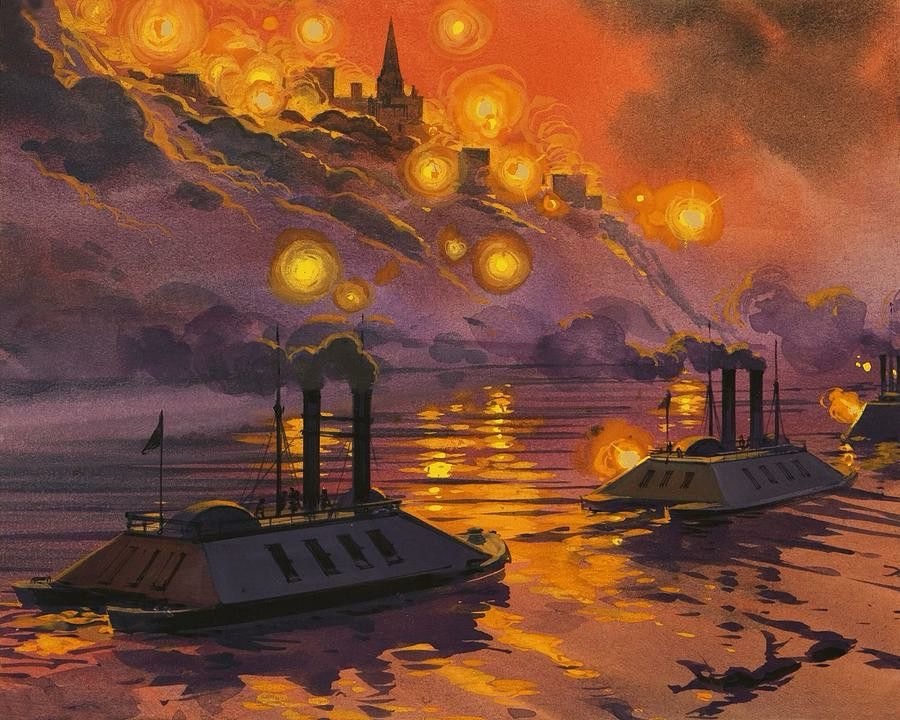
    I was looking for Civil War paintings today and came across this one that really stood out to me.

    The Civil War wasn’t just fought in trenches and open fields. Some of its most intense and overlooked battles happened on the water. The fight for control of the Mississippi River was brutal, relentless, and absolutely crucial to the outcome of the war.

    This image really brings that to life. Union ironclads moving silently under the cover of night, their engines hissing, the sky exploding with fire as they face Confederate batteries dug into the bluffs above. It captures the Vicksburg Campaign, one of the most pivotal fights of the war.

    Vicksburg was the key to controlling the Mississippi. For the Union, taking the city meant splitting the Confederacy in half and cutting off a vital supply route. For the Confederates, it was one of their last strongholds in the West. General Grant knew it couldn’t be taken easily by land alone, so the Navy stepped in. Union gunboats launched heavy nighttime bombardments and ran dangerous gauntlets under fire to support the siege.

    Ironclads like the USS Benton, Carondelet, and Louisville traded fire with well-fortified Confederate positions. The noise must have been something unimaginable . Explosions lit up the river. Smoke thickened the air until the sky nearly disappeared. It wasn’t just war, it was chaos and destruction on a massive scale, which seemed to be a common theme of the American Civil War.

    After weeks of siege and naval support, Vicksburg finally surrendered on July 4, 1863. The same week as Gettysburg (the day after actually). Together, those two victories shifted the course of the entire war in favor of the Union.

    The naval battles of the Civil War rarely get the attention they deserve. But this image says a lot without needing words. It’s haunting, powerful, and a reminder that the war on the water was just as important as the one on land.

  • Wacky Wednesday. Old Douglas

    Wacky Wednesday. Old Douglas

    Old Douglas: The Camel Who Marched to War

    When people think of the American Civil War, they imagine soldiers in blue and gray, 12 pounder cannons, and battles from Gettysburg to Shiloh. But few would picture a camel trekking through camp alongside Confederate infantrymen. Yet that’s exactly what happened.

    Old Douglas was a dromedary camel, and his journey into American military history began long before the Civil War. In the 1850s, the U.S. Army launched what became known as the Camel Corps experiment. The idea, backed by then Secretary of War, Jefferson Davis, (yes that one you may have heard of) was to import camels from the Middle East and North Africa to serve as pack animals in the dry and rugged terrain of the American Southwest. Camels proved more durable than horses or mules, but the project never gained long-term support. By the time the Civil War broke out, the camels were scattered or sold off.

    One of those camels, Douglas, ended up in the ranks of the 43rd Mississippi Infantry. Though he startled horses and drew curious stares, he was used to carry gear and supplies and quickly became a familiar presence in the regiment. To many of the men, he was more than just a beast of burden. He was part of the unit.

    Douglas marched with the soldiers, stood by during long encampments, and endured the same conditions they did. When the regiment came under fire at the Siege of Vicksburg, Douglas was shot and killed by a Union sharpshooter. Reports say the men were furious. Some stories claim they hunted down the shooter. Others say they gave Douglas a soldier’s burial not as a mascot, but as a comrade.

    That story might sound strange or even absurd but for me, it resonates deeply.

    I served as an infantryman in Afghanistan. We didn’t have camels in our ranks (although I saw plenty of them), but we did have stray dogs that wandered into our outposts and decided to stay. They weren’t official, they didn’t follow orders, but they were ours. In a place where everything was harsh and uncertain, those dogs gave us comfort. They made us laugh. They reminded us we were human.

    I understand why the men of the 43rd Mississippi loved Old Douglas. War strips everything down to survival, but even in that environment, small sources of connection and companionship become something sacred. Whether it’s a dog in a forward operating base in the mountains of Afghanistan or a camel in a Civil War camp in Mississippi, those moments of familiarity mean more than people realize.

    Old Douglas may seem like a historical oddity and he is a “Wacky Wednesday” kind of fact. But his story is more than that. It’s a reminder of how strange, human, and deeply personal war really is. He may have looked out of place in the American South, but to the men who marched beside him, Douglas belonged as one of their own.

    And honestly he deserves to be remembered that way. Just like I remember the dogs in Afghanistan.

    One of the Dogs in Afghanistan. We named her Lazy. She was anything but Lazy. Followed us everywhere we went.
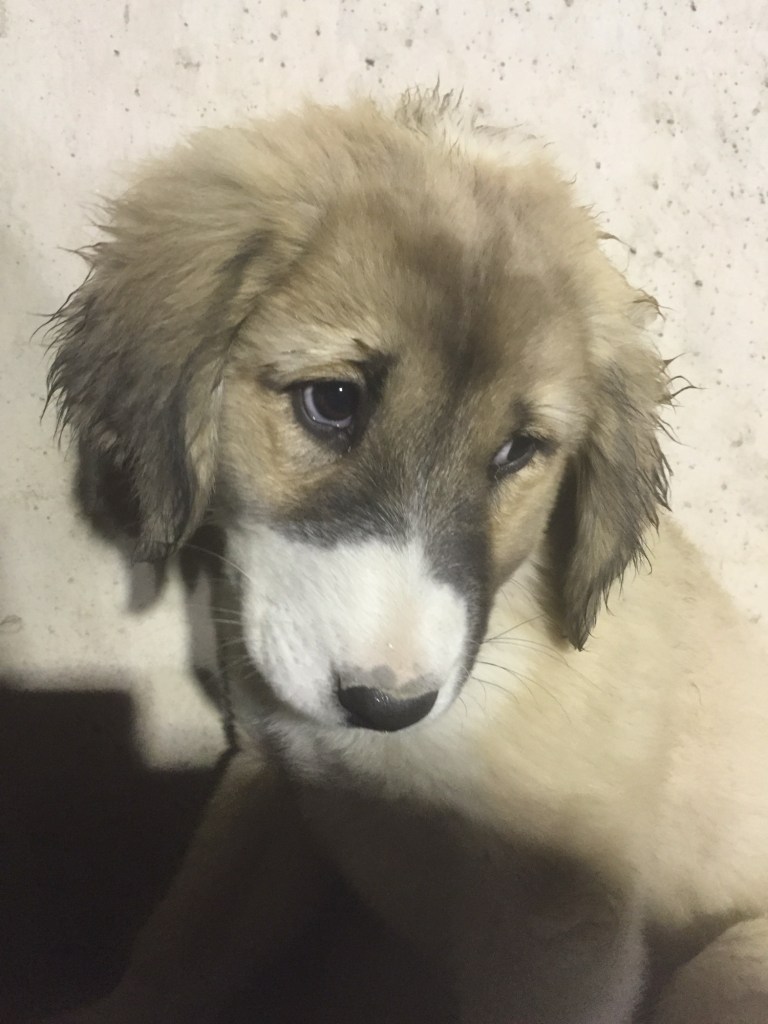
    One of her puppies. This was Spazz.
    Another of her pups. This was Poof.

    Sources:

    American Battlefield Trust – Old Douglas the Camel: https://www.battlefields.org/learn/articles/old-douglas-camel

    Daniel, Larry J. Cannoneers in Gray: The Field Artillery of the Army of Tennessee, 1861–1865. University of Alabama Press, 2012.

    Harris, David. The United States Camel Corps: An Army Experiment. Texas A&M University Press, 2006.

    U.S. Army Center of Military History – The Camel Corps: https://history.army.mil/news/2011/110400a_camel.html