Category: Flag Friday

  • Flag Friday: Cleburne’s Division – The Hardee Flag

    Flag Friday: Cleburne’s Division – The Hardee Flag

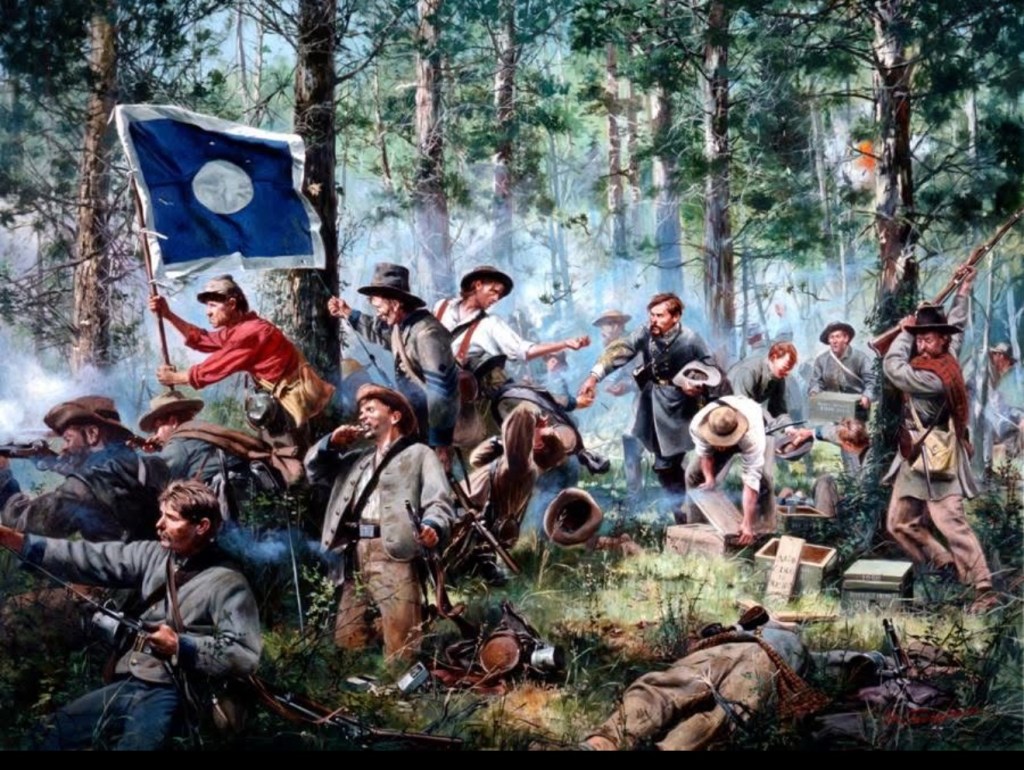
    No stars. No stripes. No flashy colors. Just a deep blue field with a plain white circle in the center. That’s it.

    But when this flag showed up on a battlefield, Union troops knew they were in for a fight. It wasn’t just another banner waving in the smoke it was a warning. This meant Cleburne’s Division was coming. And that meant trouble.
    This was the battle flag carried by some of the most disciplined and aggressive Confederate soldiers in the Western Theater. It wasn’t about style. It was about identity. And this flag became the visual identity of a division that earned its reputation in blood and fire. From the thick woods of Chickamauga to the high slopes of Missionary Ridge, and from the brutal trench fights at Pickett’s Mill to the outright slaughter at Franklin, this flag was there. It saw it all.

    These weren’t just soldiers, but they were fighters. Many were Irish immigrants fresh off the boat, others were poor Southern farmers, and some were hardened Texans and Arkansans who’d been in the ranks since Shiloh. What they had in common was a fierce loyalty to their general, their comrades, and the cause.

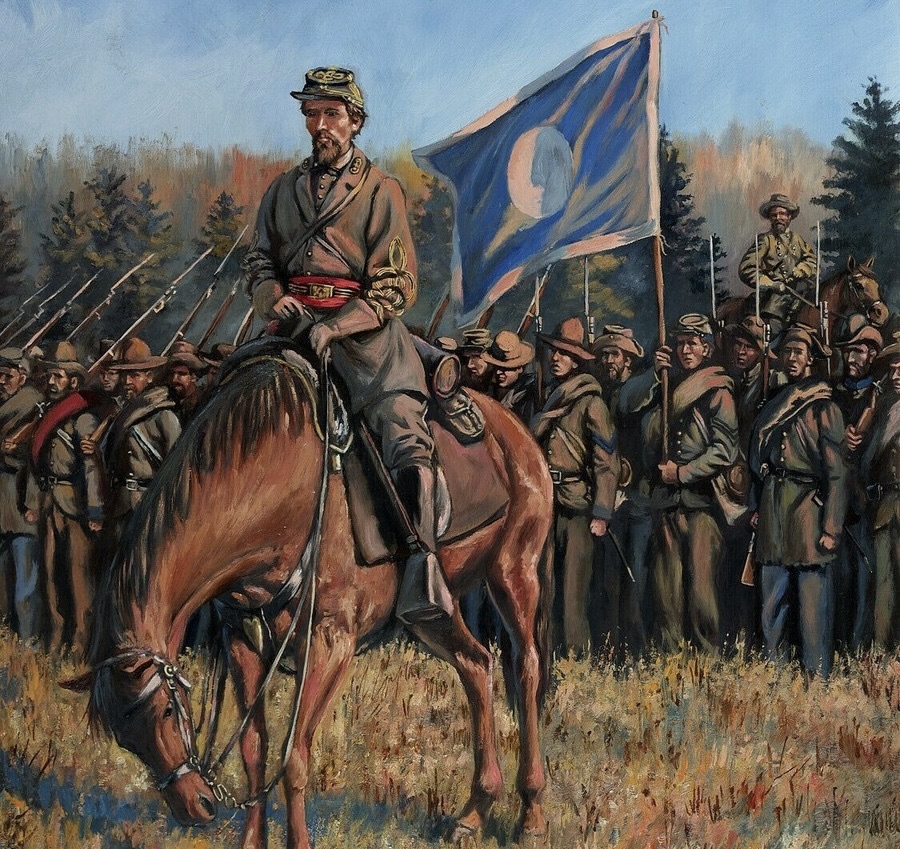
    At the center of it all was Major General Patrick Cleburne. Irish-born, a former British soldier, and easily one of the most respected Confederate commanders of the war. His troops adored him. His fellow officers respected him. Even Union generals knew his name and feared his presence on the battlefield. They called him the “Stonewall of the West,” and it fit. He was sharp, calm under pressure, and deadly when the time came to strike.

    At Franklin, Cleburne met his end. He was killed in one of the most hopeless frontal assaults of the war, sword drawn, charging straight into the guns on foot. He wasn’t behind the line. He wasn’t giving orders from a hill. He was up front, as always and the Hardee flag was right there with him.

    There’s a quote that stuck with me and inspired me to write this. 

    “General Patrick Cleburne was killed. He had his sword drawn and was riding in front of his men, leading the charge, when he was shot and instantly killed. I saw him after the battle — his face looked calm and as though he were asleep. A more gallant soldier never wore the gray, nor drew blade in any cause, right or wrong. Cleburne was the idol of the Army of Tennessee.” – Sam Watkins, 1st Tennessee Infantry, on the death of Maj. Gen. Patrick Cleburne at Franklin

    That’s why this flag hits differently.

    It’s not just about design. It’s what it stood for.  The grit, the resolve, and the quiet kind of courage. The Hardee flag is a perfect fit for the division it represented: plain, no-nonsense, and deadly serious. No frills. No politics. Just fight.
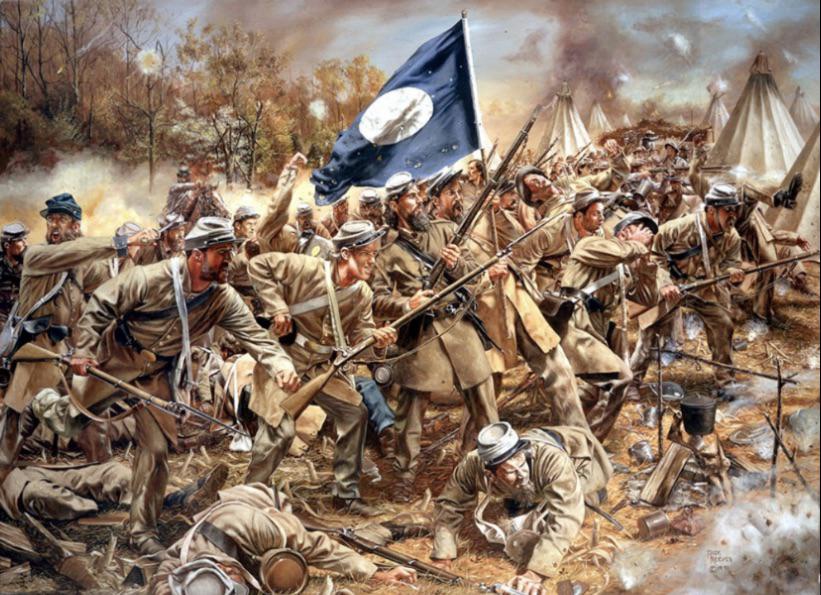
    Image Credits:

    1. “Hell in the Western Woods” – Painting by Don Troiani

    2. “General Patrick Cleburne” – Art by Mark Maritato

    3. “Into the Fight” – Also by Don Troiani

  • First Flag Friday

    First Flag Friday

    While not actually Friday, this post is part of a weekly series honoring Civil War flags and the stories sewn into their fabric. I’m reviving this series after Instagram removed my previous post — this time, it’s staying.

    A Regiment Forged in Fire

    The 26th North Carolina Infantry Regiment was formed in August 1861, largely composed of young men from western North Carolina. By 1863, it had grown into the largest regiment in the Army of Northern Virginia, with nearly 900 men under arms. Their commander, Colonel Henry King Burgwyn Jr., was just 21 years old, a boy in age and was known as the “Boy Colonel.” As someone who turned 21 in the Army I could not imagine leading 900 men when I could hardly lead myself…

    The regiment’s legacy would be defined by a single brutal day: July 1, 1863, on the outskirts of Gettysburg, Pennsylvania, you have probably heard of it and if you have not you must be looking up color combos for your wedding (Blue and Gray get it…).

    Gettysburg: The Slaughter at McPherson’s Ridge

    As the Battle of Gettysburg opened, the 26th North Carolina advanced as part of General Heth’s division, crashing into Union troops of the famed Iron Brigade, specifically the 24th Michigan Infantry, one of the toughest and best equipped regiments in the Union Army.

    The two sides fought at point-blank range through the woods and open fields of McPherson’s Ridge, exchanging fire in a near-suicidal contest of will. Muskets overheated. Trees splintered. Men collapsed in rows.

    Colonel Burgwyn, leading from the front, personally took the regimental colors after multiple color bearers had fallen. He was struck in the side and died shortly after, uttering only, “Tell my mother I die with my face to the enemy.” Honestly, some of the most incredible last words you could imagine.

    Casualties That Shocked Both Sides

    By the time the smoke cleared, the 26th had lost 588 men out of roughly 850 engaged—more than 70% casualties in a single day, the highest regimental losses suffered by either side at Gettysburg. Over 13 color bearers were shot down while carrying the flag.

    The 24th Michigan, though victorious on the field, suffered nearly 400 casualties themselves. The fight between the two regiments was so intense that it’s still cited in military studies of small unit combat.

    Two days later, the remnants of the 26th participated in Pickett’s Charge, advancing again under fire. Only around 80 men answered roll call after the battle ended.

    The Flag That Would Not Fall

    The regiment’s battle flag, a Confederate standard, was pierced by dozens of bullets, soaked in blood and gunpowder, and nearly captured several times. After the war, it was returned to North Carolina and has since become one of the most iconic Confederate flags in existence. Not because of what it symbolized politically, but because of the story it tells about sacrifice, command, and loss. (Can’t be banned here Instagram HA!)

    Legacy and Memory

    The 26th North Carolina is memorialized today with monuments at Gettysburg and in North Carolina. Their story is often cited not to glorify war, but to illustrate the devastating human cost of loyalty, leadership, and civil conflict.

    The flag of the 26th North Carolina still exists. It has been preserved and displayed, most notably in Raleigh during special exhibitions. The blood on it is real. The holes are real. The deaths were real.

    Sources & Further Reading