Blogs

  • How the Hell Did Braxton Bragg End Up in Charge?

    How the Hell Did Braxton Bragg End Up in Charge?


    You ever read about a Civil War battle, see the name Bragg, and just let out a sigh? Same. I’ve probably done it a hundred times now. The dude lives rent free in my head, unibrow and all. But back to the real conversation. Thinking of Chickamauga? Sigh. Perryville? Sigh. The man seemed to pop up everywhere you didn’t want him.

    But here’s the thing I keep coming back to: how did Braxton Bragg keep ending up in command when everybody hated him and he was objectively awful at the job?

    I was reading about this recently and it makes more sense now that I take it into context. Mind you, this wasn’t just hindsight. People at the time thought he sucked. Honestly just about everyone thought this (minus one very important person who we will come back to). His officers hated him. His men hated him. Even his own horse probably hated him. I don’t know anything about his horse but you get the point.

    And yet… there he was. Over and over again. In charge.


    The Resume of a Disaster

    Bragg had a decent early military record you could argue. Mexican-American War vet. Artillery guy. Got some praise for discipline and logistics. But once the Civil War kicked off and he was given real command responsibility? It all went downhill fast. Some leaders work better with smaller unit sizes. You might think of someone like Burnside who did well in Carolina, but did not do so well in Fredericksburg or Petersburg. But I still can’t defend Bragg.

    Bragg argued constantly with subordinates, made half-baked strategic decisions, and couldn’t hold onto a win to save his life. Even when he won.

    Perryville? Tactical success, but he gave up the field. This drives me insane. Davis defended the tactical retreat too! Sorry, Bragg called it a tactical withdraw… Chickamauga? Legit Confederate victory but he let the Union keep Chattanooga because he didn’t follow through. We always talk about how much McClellan did the same thing, but the difference is Bragg was WINNING.


    The “Jeff Davis” Problem

    This is the heart of the issue: Jefferson Davis liked him. They were old friends from the pre-war army. Davis backed him no matter how many officers begged for Bragg’s removal.

    It’s like when your boss keeps promoting their college roommate. Meanwhile, the rest of the team is screaming into the void. Davis thought Bragg was “dependable” but dependable at what? Losing momentum?


    Morale? What is that?

    There are letters, reports, and diary entries that straight-up say: “We hate this guy.” William J. Hardee, Leonidas Polk, and others tried to oust him. At one point, half his corps commanders were actively working to get him fired.

    And the best part? Bragg would accuse them of being the problem. It was always someone else’s fault. Was Bragg an idiot, a narcissist or just naïve? If you read the book Company Aytch by Sam Watkins, you will understand Bragg from the average soldier’s perspective. Their feelings about Bragg were negative. Very negative. It is funny because as a solider in the US Army one of the biggest and most well-known bases is Fort Bragg. I think the unibrow convinced someone he needs a base named after him.

    Imagine being a soldier and realizing Bragg is in charge of your unit? Shameless plug for my reel that I made.


    Why Did He Stay?

    The answer isn’t satisfying, but it’s real it seems like Confederate leadership was built more on loyalty and politics than performance. Davis was loyal to his friends, even when it hurt the war effort. Bragg was familiar. Bragg was a friend. That counted for more than effectiveness.

    Better generals were out there. The press openly called for Bragg to go. But Davis refused until it was far too late.


    Final Thought

    The Civil War has no shortage of “what were they thinking?” moments. But Bragg’s continued command might just be the worst of them. He just wasn’t the guy for the job. And yet, there he was. Battle after battle.

    Sometimes I wonder how different the Western Theater might’ve looked if literally anyone else had been in charge. But if nothing else, Bragg gives us a perfect example of what not to do in leadership. Maybe West Point can teach what Bragg did so we can learn the opposite.

  • Time to Rethink This Blog

    I originally started this blog to expand on my Civil War Instagram posts. You know, longer versions of stuff I was already sharing. But honestly? It feels very redundant. And nobody is reading these blog posts anyway most likely but for maybe the one person who is… thank you!

    I don’t want this to be a place where I just copy/paste captions and dress them up with extra paragraphs like it’s a school paper. That’s boring. For you and for me. Maybe I’ll do it once in a while but for now I have other plans.

    This blog is now just me, Tyler, yapping. Rambling. Thinking out loud about weird Civil War stuff, underrated regiments, flags I like, generals I love (or don’t), and whatever else is rattling around in my head that week. Just me, you and history. I guess I’ll still share this to my instagram stories to make sure people see it, but I don’t think I’ll tie the posts to this anymore. It’s becoming a lot of work for not much benefit. Like I said in the past I’m not doing this for money so I just want to do what’s fun and what seems to get people engaged which does not seem to be happening.

    If you’re into obscure facts, wild stories, personal takes, or just want to hang out with someone who’s way too into 1860s America, welcome! You’re in the right place.

    First topic: I am not even sure yet. I guess as we go along and my brain starts stewing I’ll figure it out.

    Thanks for being here. Let’s make this fun again. Also feel free to message me on instagram or email at Tyler@bluevsgray.com for recommendations or anything.

    Thinking about doing voice over videos and maybe a podcast but not too sure on that. My voice is annoying as hell and I am a better writer than speaker.

  • Wacky Wednesday: The Glowing Wounds of Shiloh

    Wacky Wednesday: The Glowing Wounds of Shiloh

    The Battle of Shiloh was a bloodbath.

    April 1862. Over 23,000 casualties in just two days. Muddy ground, pouring rain, chaos everywhere. After the fighting stopped, the battlefield was littered with the wounded some stuck out there for hours, even days, waiting for help.

    Then something happened that no one expected. Some of the wounds started to glow. Soldiers lying in the dark with a weird blue-green light coming from their injuries. Spooky as hell, but even stranger many of those guys ended up surviving. Although nobody got Spider-Man powers sadly.

    Artistic rendering of a wounded Civil War soldier glowing on the battlefield inspired by accounts from the Battle of Shiloh in 1862.

    It didn’t make sense. Until about 140 years later. Modern researchers think a bioluminescent bacteria in the Tennessee soil, Photorhabdus luminescence (I can’t even pronounce that just know it glows lol) into the wounds. Because of the cold temps and weakened immune systems, the bacteria thrived. And instead of killing the soldiers, it actually helped by wiping out more dangerous microbes.

    Bioluminescent Photorhabdus luminescens bacteria glowing in laboratory petri dishes — the same kind believed to have caused Angel’s Glow during the Civil War.

    So what looked like some ghostly phenomenon may have actually saved lives.

    Soldiers back then didn’t know the science. They just called it Angel’s Glow.

    And honestly, who could blame them It’s one of those rare moments where the horror of war meets something weirdly beautiful.

    Not a miracle, maybe but close enough.

    I read that scientists recreated battlefield conditions in a lab to test this theory and sure enough, the bacteria glowed and outcompeted nastier ones. The phenomenon probably wouldn’t happen today with modern medicine. But in 1862? It just might’ve been the difference between life and death.

    If you liked this post, consider subscribing. I don’t run ads or sell anything. I just love Civil War history and enjoy connecting with people who care about it too since my friends and family don’t care about this it’s a nice way for me to meet likeminded people.

    📚 Footnotes

    Smithsonian Magazine, “Civil War Soldiers Had Wounds That Glowed—and Healed Faster,” https://www.smithsonianmag.com/science-nature/civil-war-soldiers-had-wounds-that-glowedand-healed-faster-115741280/

    U.S. National Library of Medicine, Angel’s Glow at the Battle of Shiloh, https://www.ncbi.nlm.nih.gov/pmc/articles/PMC3757937/

    Scientific American, “Angel’s Glow: The Bacteria That Saved Soldiers’ Lives at Shiloh,” https://www.scientificamerican.com/article/angels-glow-in-the-dark-wounds-of-civil-war-soldiers/

    PBS American Experience, “The Mysterious Angel’s Glow,” https://www.pbs.org/wgbh/americanexperience/features/mystery-angels-glow/

    National Geographic Kids, “The Glowing Wounds of Shiloh,” https://kids.nationalgeographic.com/history/article/shilohs-glowing-wounds

  • Friends of the Blue and Gray: Old Baldy — The Warhorse Who Wouldn’t Quit

    Friends of the Blue and Gray: Old Baldy — The Warhorse Who Wouldn’t Quit

    This week, we remember Old Baldy, the battle-hardened horse of Union General George G. Meade and one of the most wounded, loyal, and resilient animals of the entire war.

    A Horse or a Fighter?

    Old Baldy wasn’t a show horse. He was a sturdy bay gelding with a broad white blaze and an awkward gait. Originally purchased by General Meade in Washington, D.C., Baldy was named after that distinctive bald-faced marking. What he lacked in elegance, he made up for in guts.

    Meade rode Baldy into some of the most brutal fighting of the Civil War. The two became nearly inseparable — and Baldy proved himself just as brave and determined as the general on his back.

    Old Baldy was wounded in five different battles (although some people say he was wounded fourteen times), yet kept returning to service. Here’s a record of his injuries:

    First Bull Run (1861): Hit in the nose by a shell fragment.

    Second Bull Run (1862): Shot in the right hind leg. Antietam (1862): Shot through the neck and left for dead. He was later found grazing alone in a field, injured but alive.

    Fredericksburg (1862): Received a minor wound, but continued on.

    Gettysburg (1863): A bullet passed through General Meade’s trousers and lodged in Baldy’s stomach. For the first time ever, Baldy refused to charge forward and Meade thought his friend wouldn’t survive.

    But he did. He carried that final bullet in his body for the rest of his life.

    A Hero’s Retirement

    After Gettysburg, Meade reluctantly retired Old Baldy from field service. The general sent him to a quiet farm near Philadelphia, where he could live out his days in peace. But Baldy wasn’t forgotten. After the war, he joined Meade again for parades, veterans’ gatherings, and remembrance events.

    In 1872, when Meade died, Baldy walked riderless in the funeral procession a silent salute to the man he had served for years.

    A Strange But Lasting Memorial

    Old Baldy died in 1882 at the age of 30. But even in death, his legacy endured.

    Veterans from Meade’s former command had Baldy’s head preserved and mounted as a memorial. Today, his remains are displayed at the Grand Army of the Republic Civil War Museum in Philadelphia. Some might find it strange but to those who rode beside him, it was the least they could do.

    More Than a Horse

    Old Baldy wasn’t just a mount. He was a soldier. A survivor. A witness to history. He carried one of the most important Union generals through some of the darkest and bloodiest moments of the war and came back again and again.

    That’s why he’s this week’s Friend of the Blue and Gray.

  • Flag Friday: Cleburne’s Division – The Hardee Flag

    Flag Friday: Cleburne’s Division – The Hardee Flag

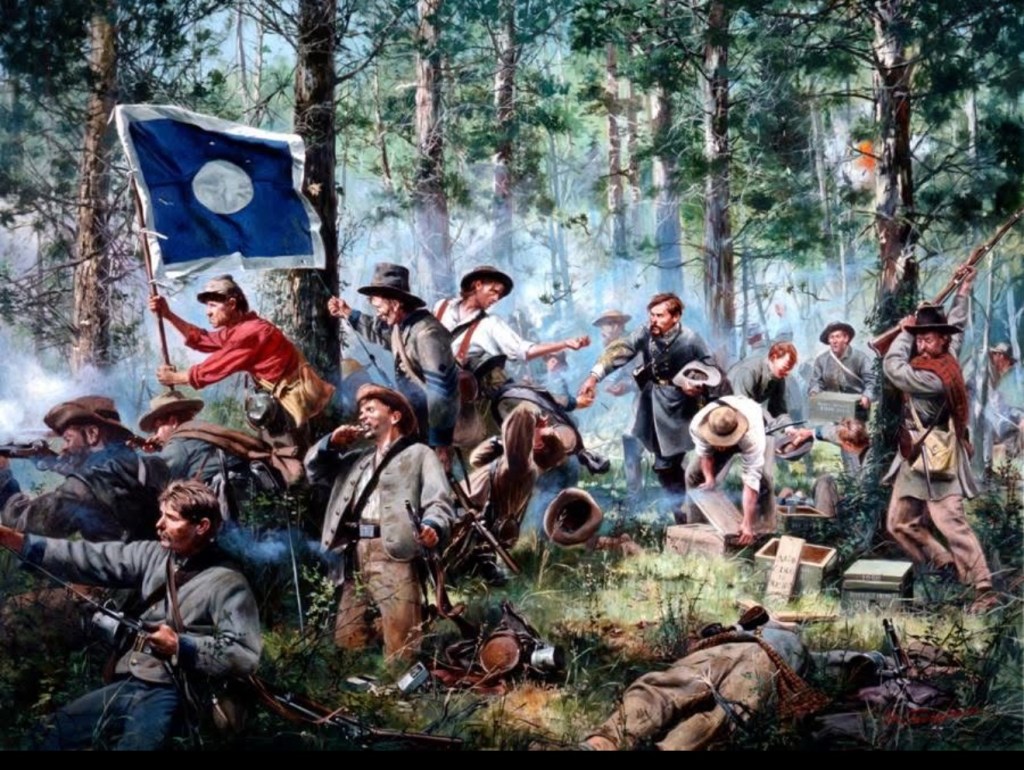
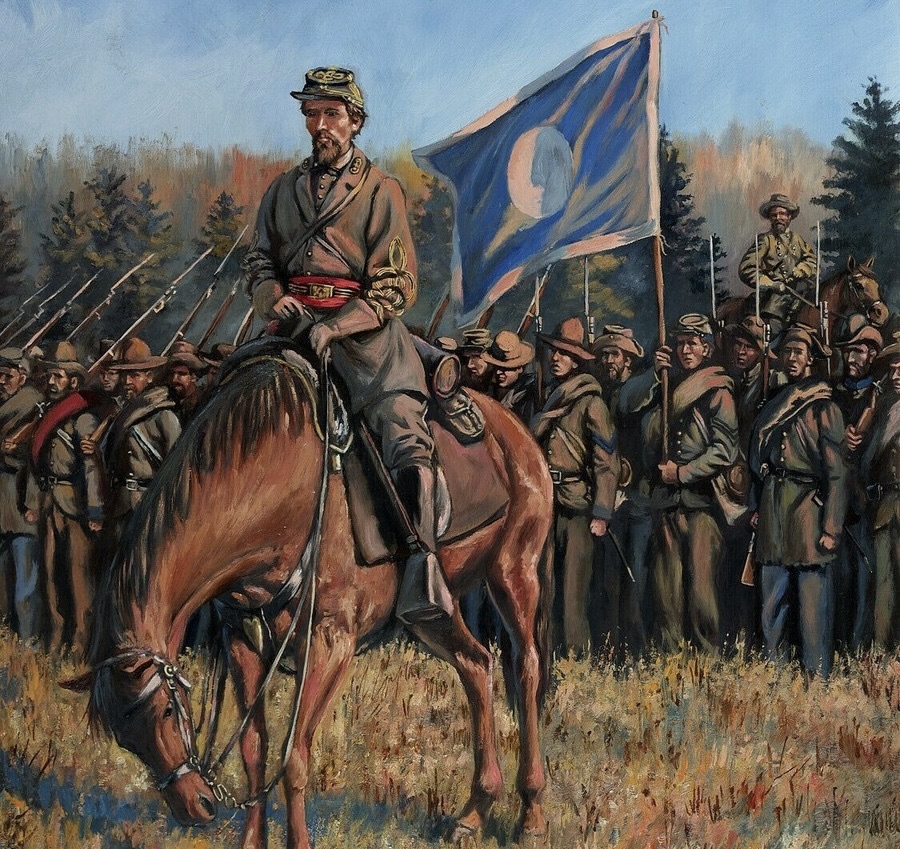
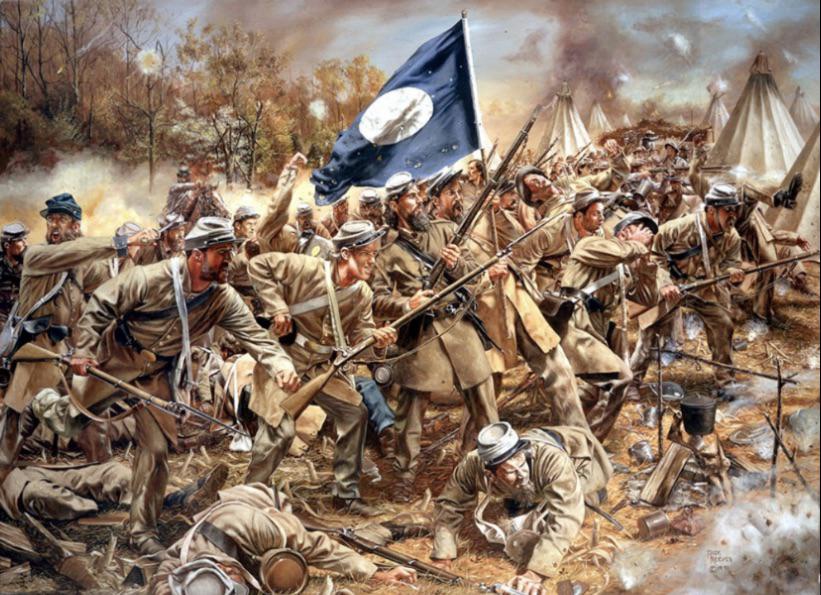
    No stars. No stripes. No flashy colors. Just a deep blue field with a plain white circle in the center. That’s it.

    But when this flag showed up on a battlefield, Union troops knew they were in for a fight. It wasn’t just another banner waving in the smoke it was a warning. This meant Cleburne’s Division was coming. And that meant trouble.

    This was the battle flag carried by some of the most disciplined and aggressive Confederate soldiers in the Western Theater. It wasn’t about style. It was about identity. And this flag became the visual identity of a division that earned its reputation in blood and fire. From the thick woods of Chickamauga to the high slopes of Missionary Ridge, and from the brutal trench fights at Pickett’s Mill to the outright slaughter at Franklin, this flag was there. It saw it all.

    These weren’t just soldiers, but they were fighters. Many were Irish immigrants fresh off the boat, others were poor Southern farmers, and some were hardened Texans and Arkansans who’d been in the ranks since Shiloh. What they had in common was a fierce loyalty to their general, their comrades, and the cause.

    At the center of it all was Major General Patrick Cleburne. Irish-born, a former British soldier, and easily one of the most respected Confederate commanders of the war. His troops adored him. His fellow officers respected him. Even Union generals knew his name and feared his presence on the battlefield. They called him the “Stonewall of the West,” and it fit. He was sharp, calm under pressure, and deadly when the time came to strike.

    At Franklin, Cleburne met his end. He was killed in one of the most hopeless frontal assaults of the war, sword drawn, charging straight into the guns on foot. He wasn’t behind the line. He wasn’t giving orders from a hill. He was up front, as always and the Hardee flag was right there with him.

    There’s a quote that stuck with me and inspired me to write this. 

    “General Patrick Cleburne was killed. He had his sword drawn and was riding in front of his men, leading the charge, when he was shot and instantly killed. I saw him after the battle — his face looked calm and as though he were asleep. A more gallant soldier never wore the gray, nor drew blade in any cause, right or wrong. Cleburne was the idol of the Army of Tennessee.” – Sam Watkins, 1st Tennessee Infantry, on the death of Maj. Gen. Patrick Cleburne at Franklin

    That’s why this flag hits differently.

    It’s not just about design. It’s what it stood for.  The grit, the resolve, and the quiet kind of courage. The Hardee flag is a perfect fit for the division it represented: plain, no-nonsense, and deadly serious. No frills. No politics. Just fight.

    Image Credits:

    1. “Hell in the Western Woods” – Painting by Don Troiani

    2. “General Patrick Cleburne” – Art by Mark Maritato

    3. “Into the Fight” – Also by Don Troiani