Author: Tyler

  • Wacky Wednesday: The Cursed Submarine

    Wacky Wednesday: The Cursed Submarine

    The H.L. Hunley was the first submarine to ever sink an enemy ship in combat.

    Sounds great and I guess it is, until you realize it was powered by eight dudes hand-cranking a propeller in the dark, like some haunted Civil War rowing machine. Cramped, hot, pitch black, and barely big enough to sit upright this thing was more iron tomb than anything.
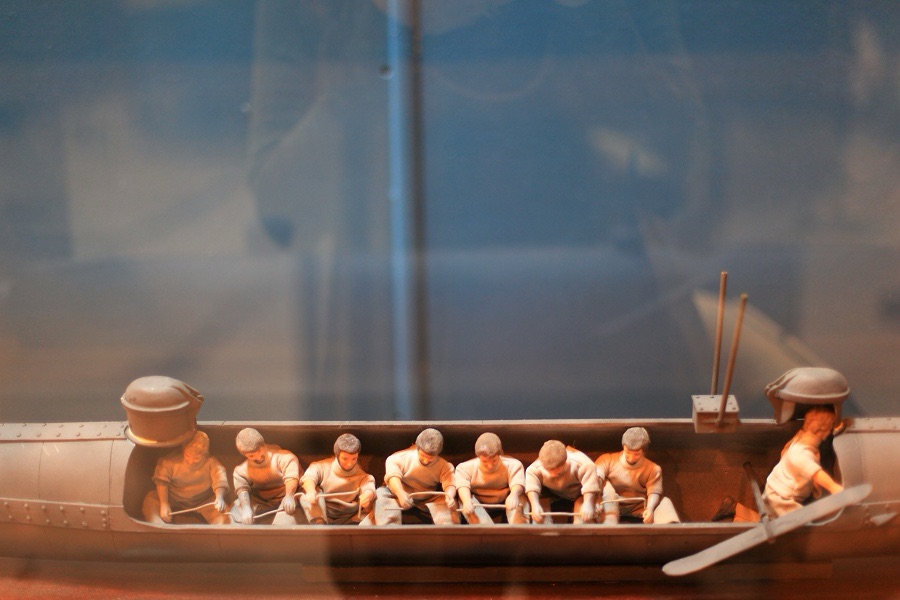
    Scale model of the H.L. Hunley submarine showing eight Confederate sailors hand-cranking the propeller shaft inside the cramped interior.

    In 1864, the Hunley pulled off what no one thought was possible. It crept up on the Union warship USS Housatonic off the coast of Charleston, planted a torpedo on a long spar mounted to its nose, and blew the ship out of the water.

    Mission accomplished. First sub-to-ship kill in world history.

    Would not be a Wacky Wednesday if it ended there.

    The Hunley never came back. It sank too.

    And here’s the wild part: this wasn’t the first time it happened. It was the third time the sub had killed everyone on board.

    Once during testing.

    Once during a training run with its inventor, Horace Hunley, on board.

    And now, even after a successful combat mission.

    Then the thing disappeared for over 130 years. No wreck, no clues just gone.

    When they finally found it in the 1990s and brought it to the surface, what they found inside was pretty terrifying. No holes in the hull. No signs of flooding or damage. Just dead.

    To this day, no one really knows how or why but it is thought that the spar torpedo used to sink the Housatonic was the culprit.

    Whatever happened, it was fast and silent.

    So yeah, the Hunley made history. But it also sank three times, killed 21 men, and vanished into legend for over a century.

    Most cursed sub in history? Probably.
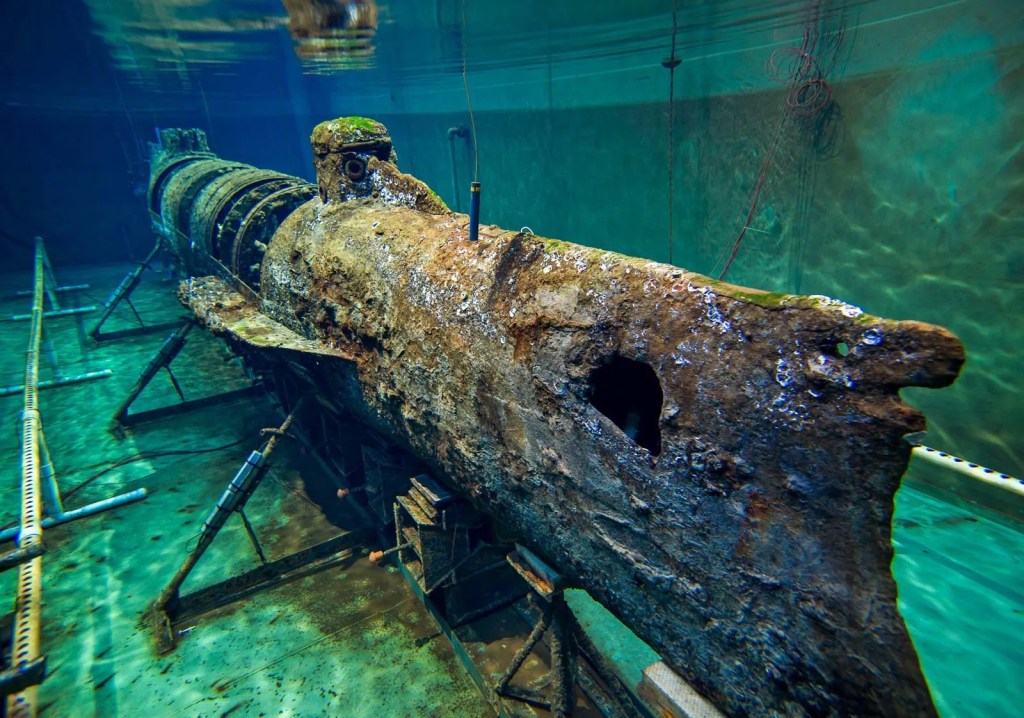
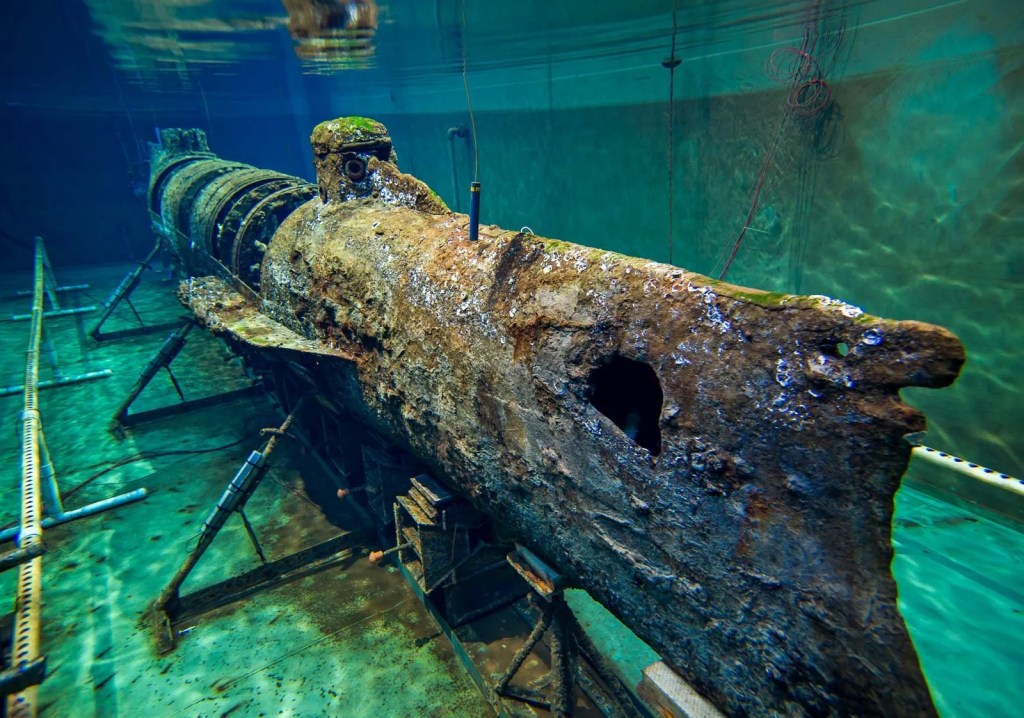
    The preserved remains of the H.L. Hunley submarine resting in a conservation tank, showing its rusted iron hull and narrow structure.

    Image 1 (Actual Submarine): Courtesy of the Friends of the Hunley, www.hunley.org

    Image 2 (Crew Model): Photo by Gerry Dincher, via Wikimedia Commons, Creative Commons license https://commons.wikimedia.org/wiki/File:Hunley_model_cutaway.jpg

    Content sources

    Friends of the Hunley – www.hunley.org National Park Service – nps.gov

    Smithsonian Magazine – The Hunley Submarine Mystery

    Naval History & Heritage Command – history.navy.mil

    Crew model photo by Gerry Dincher via Wikimedia Commons – CC BY-SA 2.0
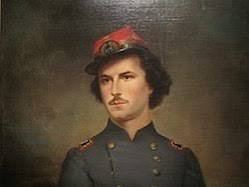
  • The First to Fall: Remembering Colonel Elmer Ellsworth

    The First to Fall: Remembering Colonel Elmer Ellsworth

    Before Gettysburg, before Antietam or Shiloh, there was Elmer Ellsworth.

    He wasn’t a general. He didn’t command thousands. But he was the first Union officer to die in the Civil War, and his death hit the North hard.

    Ellsworth was only 24. He grew up in upstate New York and eventually made his way to Illinois, where he studied law and became close friends with Abraham Lincoln. When Lincoln was elected president, Ellsworth followed him to Washington. He wasn’t just a friend. He was someone Lincoln truly trusted.

    Ellsworth had a thing for uniforms and precision. He organized the Chicago Zouave Cadets, a flashy militia unit known for their showy drills and strict discipline. When war broke out, he raised a regiment from New York City firefighters called the 11th New York Volunteer Infantry. People called them the Fire Zouaves. They were rough, loud, and fiercely loyal to Ellsworth.

    On May 24, 1861, just a day after Virginia officially joined the Confederacy, Union troops crossed the Potomac and entered Alexandria. From Washington, a huge Confederate flag could be seen flying over the Marshall House Inn. Lincoln had probably looked at it from the White House. Ellsworth decided he was going to take it down himself.

    He and a small group of men went into the inn. They climbed to the roof, cut down the flag, and started making their way back down. As Ellsworth stepped onto a staircase holding the flag, the innkeeper, James Jackson, appeared with a shotgun. He shot Ellsworth in the chest and killed him instantly. One of Ellsworth’s men shot Jackson in return.

    Just like that, the first blood had been drawn.

    Ellsworth’s body was taken back to Washington and laid in state in the White House. Lincoln was crushed. He wrote to Ellsworth’s parents, saying their son’s death was one of the most painful events of his life.

    All across the North, Ellsworth became a symbol. His face was printed on posters and memorial cards. Some Union regiments even carried flags that said “Remember Ellsworth.” His story was a rallying cry for early volunteers who saw him as a martyr for the cause.

    He didn’t die in a big battle. He didn’t go down leading a charge. But Ellsworth’s death showed the country that the war was real, and that even the brightest and best could be taken in an instant.

    He’s buried in Mechanicville, New York. People still leave flags on his grave.

    Today we remember him. Not just because he was the first to fall, but because he believed in something bigger than himself.

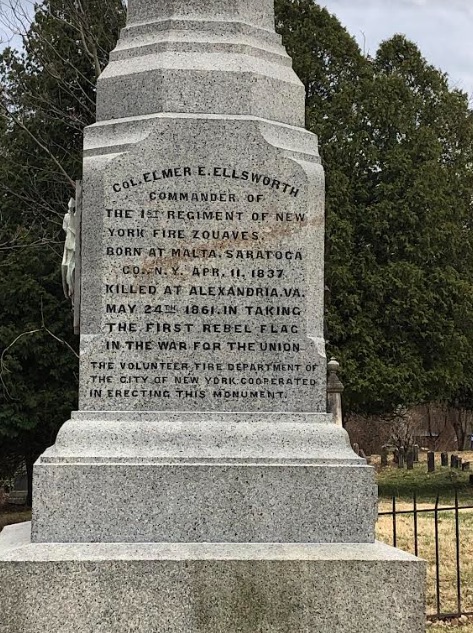
    Gravestone of Colonel Elmer E. Ellsworth, commander of the 11th New York Fire Zouaves and the first Union officer killed in the Civil War, May 24, 1861. Erected with support from the New York City Fire Department.

    Sources:

    Library of Congress. “Colonel Elmer E. Ellsworth.” Prints & Photographs Division. https://www.loc.gov/item/2003653537/

    National Park Service. “Elmer Ellsworth: Lincoln’s Friend, the Union’s First Martyr.” https://www.nps.gov/people/elmer-ellsworth.htm

    Smithsonian Magazine. “The Death of Colonel Elmer Ellsworth.” https://www.smithsonianmag.com/history/the-death-of-colonel-elmer-ellsworth-109492196/

    National Archives. “Letter from President Lincoln to the Parents of Colonel Ellsworth, 1861.” https://www.archives.gov/exhibits/american_originals/ellswort.html

  • The Ride That Changed Everything: Sheridan and the Horse named Rienzi

    The Ride That Changed Everything: Sheridan and the Horse named Rienzi

    Introducing Friends of the Blue and Gray.

    I’ve gotten a lot of requests to talk about the animals of the Civil War, so I figured it’s time to start a series. I’ll try to do this once a week either Saturday or Sunday. Welcome to Friends of the Blue and Gray. Let’s jump right in!

    October 19, 1864 – Rienzi comes thundering onto the field at Cedar Creek, carrying a general who refused to lose. The tide turned the moment they showed up.

    In a chaotic war, sometimes a man on a horse makes the difference, not a strategy or battle plan.

    That horse was Rienzi, a sleek black gelding gifted to, at the time, Colonel Philip Sheridan in 1862 by officers of the Second Michigan Cavalry. Rienzi had three white fetlocks, and a presence that turned heads. Sheridan named him after the Mississippi town where he received him, and the two would become one of the most iconic rider-horse duos of the war. Actually this name will change, but we will get to that!

    Rienzi carried Sheridan through nearly 50 engagements, including 19 major battles and two cavalry raids. He wasn’t just a mode of transportation, but he was a warhorse through and through: steady under fire, powerful under strain, fast when it mattered, and loyal no matter what.

    Sheridan on Rienzi, racing from Winchester to Cedar Creek. Twelve miles of urgency, one horse, and a general hell-bent on turning a rout into a rally.

    On October 19, 1864, Rienzi earned his legendary status. Sheridan had been away in Winchester, Virginia, when Confederate troops launched a surprise attack on his army encamped at Cedar Creek. The Union lines were breaking. Morale was slipping. Panic was spreading. Sheridan got word and mounted Rienzi.

    What followed was a ride that would live on in poems, paintings, and battlefield legend…. and internet blogs (shameless shoutout).

    Sheridan and Rienzi covered 12 miles in under two hours, galloping past retreating Union troops, shouting them back into formation, rallying them to stand and fight. The sheer sight of Sheridan charging onto the battlefield on Rienzi likely lit a fire in the ranks. The men turned, re-formed, and counterattacked.

    The Union not only held the line but they won the battle.

    A New Name

    After Cedar Creek, Rienzi was renamed Winchester, in honor of the town from which he launched that legendary ride. Sheridan never rode another horse into battle. Rienzi had earned that place for good and rightfully so, Rienzi was a faithful companion (one would say a Friend of Gray).

    Winchester stayed with Sheridan until the horse’s death in 1878. The general had his body preserved and mounted, and today you can still see Winchester on display at the Smithsonian, standing in quiet tribute to one of the most pivotal rides in American military history.

    The horse that carried Sheridan through nearly 50 engagements and one of the most legendary rides in U.S. military history.

    This wasn’t just a warhorse. He was a friend, a companion and a sign of hope. He was part of the moment that changed everything that day in 1864.

    Thanks for taking the time to read this. I actually really enjoy this new theme. Feel free to shoot me a message or an email if you want me to cover something specific.

    Make sure you check out these sources. Great reading!

    Sources:

    Smithsonian Institution – Winchester (Rienzi) Smithsonian Magazine – “Philip Sheridan’s Valiant Horse” Emerging Civil War – “A Horse Named Rienzi” American Battlefield Trust – “Sheridan’s Ride”

    Image credits :

    Image 1 (Color painting of Sheridan rallying troops): American Battlefield Trust – https://www.battlefields.org/learn/articles/sheridans-ride

    Image 2 (Black & white illustration of Sheridan’s ride): Library of Congress – https://www.loc.gov/item/2005681732/

    Image 3 (Preserved horse at the Smithsonian): Smithsonian Institution – https://americanhistory.si.edu/collections/search/object/nmah_439678

  • Fire on the River: Remembering the Fight for Vicksburg

    Fire on the River: Remembering the Fight for Vicksburg

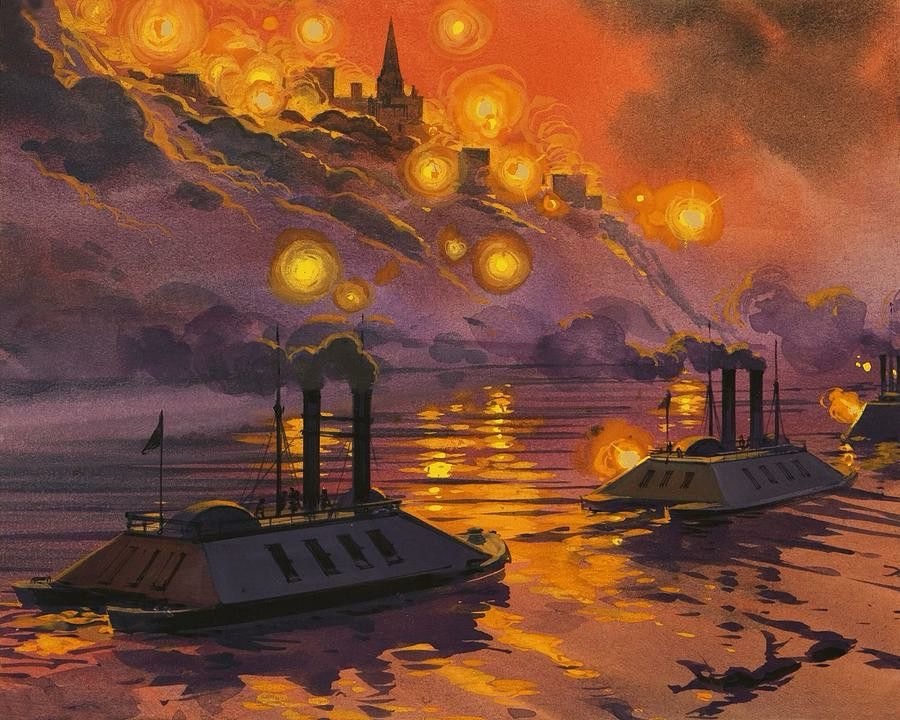
    I was looking for Civil War paintings today and came across this one that really stood out to me.

    The Civil War wasn’t just fought in trenches and open fields. Some of its most intense and overlooked battles happened on the water. The fight for control of the Mississippi River was brutal, relentless, and absolutely crucial to the outcome of the war.

    This image really brings that to life. Union ironclads moving silently under the cover of night, their engines hissing, the sky exploding with fire as they face Confederate batteries dug into the bluffs above. It captures the Vicksburg Campaign, one of the most pivotal fights of the war.

    Vicksburg was the key to controlling the Mississippi. For the Union, taking the city meant splitting the Confederacy in half and cutting off a vital supply route. For the Confederates, it was one of their last strongholds in the West. General Grant knew it couldn’t be taken easily by land alone, so the Navy stepped in. Union gunboats launched heavy nighttime bombardments and ran dangerous gauntlets under fire to support the siege.

    Ironclads like the USS Benton, Carondelet, and Louisville traded fire with well-fortified Confederate positions. The noise must have been something unimaginable . Explosions lit up the river. Smoke thickened the air until the sky nearly disappeared. It wasn’t just war, it was chaos and destruction on a massive scale, which seemed to be a common theme of the American Civil War.

    After weeks of siege and naval support, Vicksburg finally surrendered on July 4, 1863. The same week as Gettysburg (the day after actually). Together, those two victories shifted the course of the entire war in favor of the Union.

    The naval battles of the Civil War rarely get the attention they deserve. But this image says a lot without needing words. It’s haunting, powerful, and a reminder that the war on the water was just as important as the one on land.

  • Wacky Wednesday. Old Douglas

    Wacky Wednesday. Old Douglas

    Old Douglas: The Camel Who Marched to War

    When people think of the American Civil War, they imagine soldiers in blue and gray, 12 pounder cannons, and battles from Gettysburg to Shiloh. But few would picture a camel trekking through camp alongside Confederate infantrymen. Yet that’s exactly what happened.

    Old Douglas was a dromedary camel, and his journey into American military history began long before the Civil War. In the 1850s, the U.S. Army launched what became known as the Camel Corps experiment. The idea, backed by then Secretary of War, Jefferson Davis, (yes that one you may have heard of) was to import camels from the Middle East and North Africa to serve as pack animals in the dry and rugged terrain of the American Southwest. Camels proved more durable than horses or mules, but the project never gained long-term support. By the time the Civil War broke out, the camels were scattered or sold off.

    One of those camels, Douglas, ended up in the ranks of the 43rd Mississippi Infantry. Though he startled horses and drew curious stares, he was used to carry gear and supplies and quickly became a familiar presence in the regiment. To many of the men, he was more than just a beast of burden. He was part of the unit.

    Douglas marched with the soldiers, stood by during long encampments, and endured the same conditions they did. When the regiment came under fire at the Siege of Vicksburg, Douglas was shot and killed by a Union sharpshooter. Reports say the men were furious. Some stories claim they hunted down the shooter. Others say they gave Douglas a soldier’s burial not as a mascot, but as a comrade.

    That story might sound strange or even absurd but for me, it resonates deeply.

    I served as an infantryman in Afghanistan. We didn’t have camels in our ranks (although I saw plenty of them), but we did have stray dogs that wandered into our outposts and decided to stay. They weren’t official, they didn’t follow orders, but they were ours. In a place where everything was harsh and uncertain, those dogs gave us comfort. They made us laugh. They reminded us we were human.

    I understand why the men of the 43rd Mississippi loved Old Douglas. War strips everything down to survival, but even in that environment, small sources of connection and companionship become something sacred. Whether it’s a dog in a forward operating base in the mountains of Afghanistan or a camel in a Civil War camp in Mississippi, those moments of familiarity mean more than people realize.

    Old Douglas may seem like a historical oddity and he is a “Wacky Wednesday” kind of fact. But his story is more than that. It’s a reminder of how strange, human, and deeply personal war really is. He may have looked out of place in the American South, but to the men who marched beside him, Douglas belonged as one of their own.

    And honestly he deserves to be remembered that way. Just like I remember the dogs in Afghanistan.

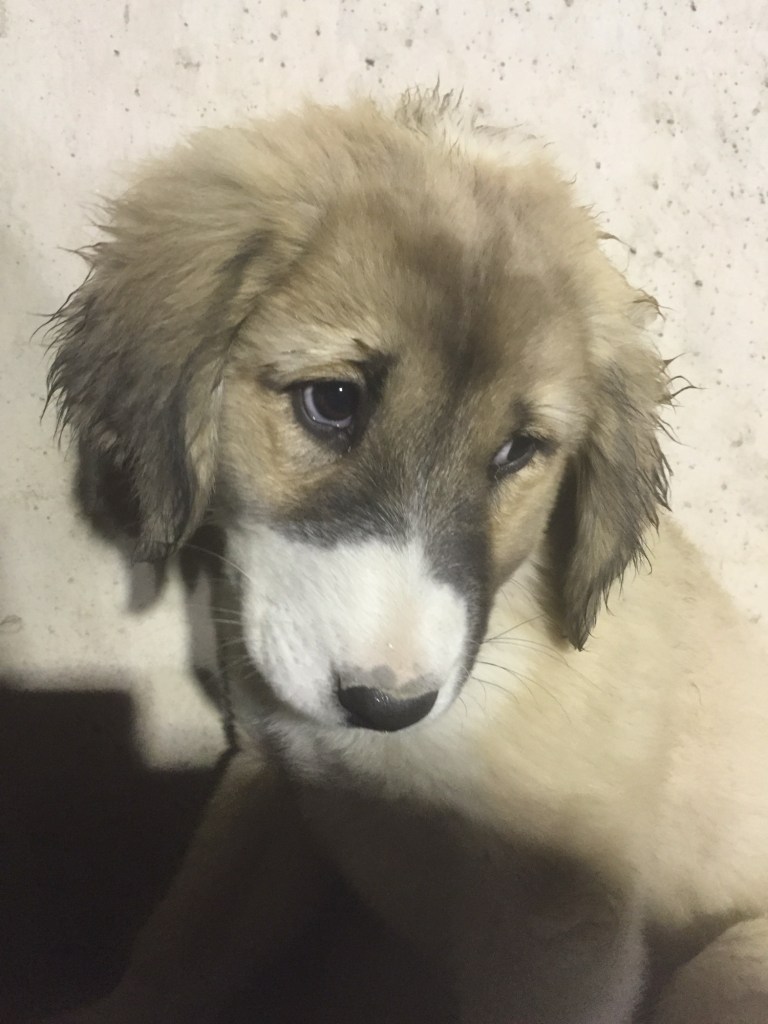
    One of the Dogs in Afghanistan. We named her Lazy. She was anything but Lazy. Followed us everywhere we went.
    One of her puppies. This was Spazz.
    Another of her pups. This was Poof.

    Sources:

    American Battlefield Trust – Old Douglas the Camel: https://www.battlefields.org/learn/articles/old-douglas-camel

    Daniel, Larry J. Cannoneers in Gray: The Field Artillery of the Army of Tennessee, 1861–1865. University of Alabama Press, 2012.

    Harris, David. The United States Camel Corps: An Army Experiment. Texas A&M University Press, 2006.

    U.S. Army Center of Military History – The Camel Corps: https://history.army.mil/news/2011/110400a_camel.html