

Three days into his new job commanding the Confederate Army of Tennessee, Gen. John Bell Hood tried to stop the Union drive on Atlanta by going on offense. He struck Maj. Gen. George H. Thomas’s Army of the Cumberland as it crossed Peachtree Creek just north of the city. Bold idea. Bad timing. The Union line held, and Hood burned through men he could not spare.
Why Fight Here?
After weeks of retreat under Gen. Joseph E. Johnston, Confederate forces fell back behind the Chattahoochee River the last major natural barrier before Atlanta. When Sherman forced a crossing in mid-July, his three Union armies fanned out: Thomas moved south toward Peachtree Creek; Schofield and McPherson angled east toward Decatur and the Georgia Railroad. Confederate leadership in Richmond lost patience with Johnston’s defensive withdrawals and replaced him with Hood on July 17, hoping for a stand-up fight to save the city.
Hood’s Plan
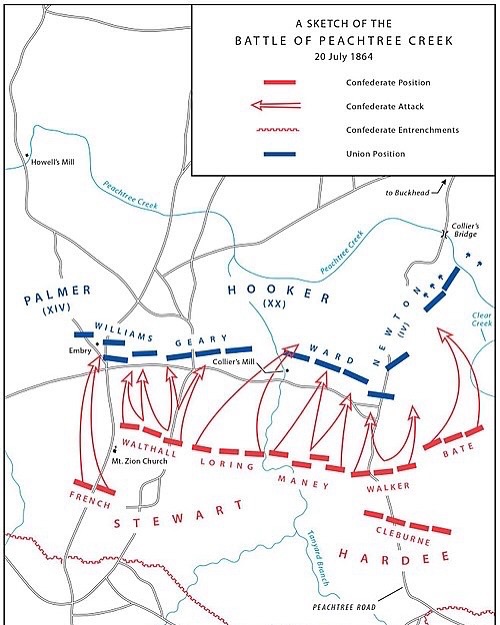
Hood saw an opportunity: Thomas’s army was partly over the creek, partly not, and there were gaps between Sherman’s widely spaced columns. Hood ordered Lt. Gen. William J. Hardee and Gen. A. P. Stewart to attack in echelon on July 20 “everything on our side of the creek to be taken at all hazards” drive the Federals west toward the Chattahoochee, and smash Thomas before Schofield or McPherson could intervene. If it worked, Hood might cripple a third of Sherman’s total force.
What Went Wrong
Morning developments forced Hood to shift his entire line right to confront unexpected Union pressure east of Atlanta, eating up precious hours. By the time Hardee and Stewart were realigned, roughly 90 minutes lost, the trailing elements of Thomas’s army had crossed Peachtree Creek and begun digging in on higher ground south of the stream. The Confederates attacked late and against troops no longer strung out.
The Fighting
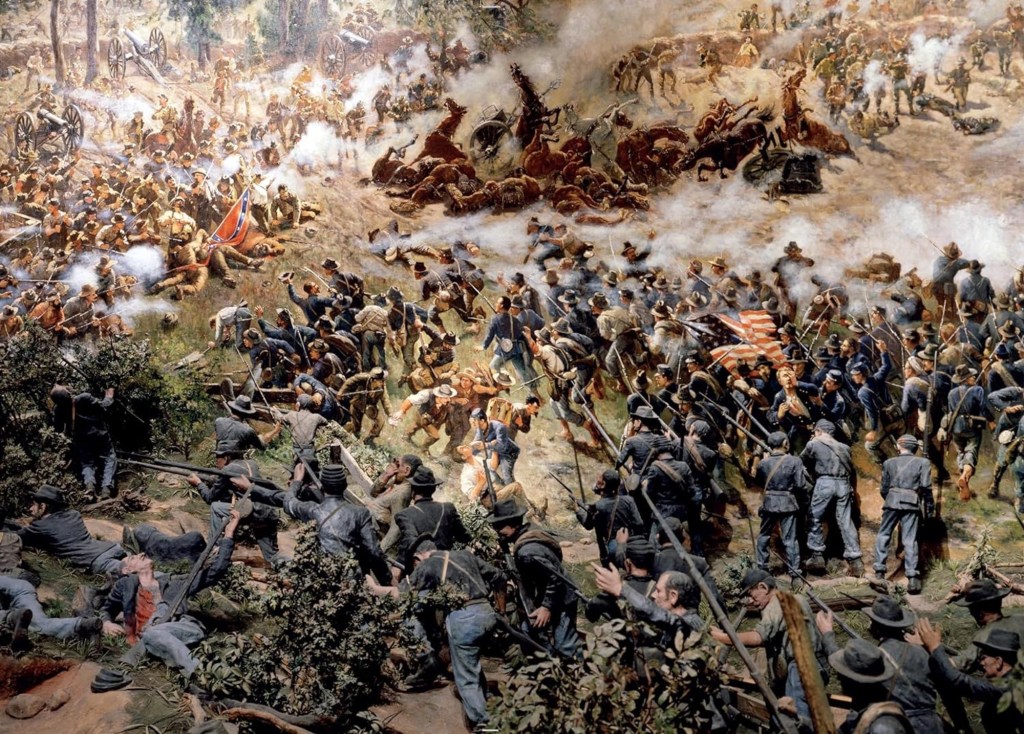
Hardee opened (belatedly) around mid-afternoon. Parts of his lead divisions became disoriented in thick ground between the Union and Schofield sectors; others charged into prepared positions and were cut up by musketry and artillery. Stewart’s corps then went in, battering the Union XX Corps line: brief penetrations, local crises, but no sustained breakthrough. Union commanders refused flanks, plugged gaps, and counterfired with entrenched artillery. By early evening, the assaults had spent themselves and Confederate forces pulled back. The field belonged to Thomas.
Casualties: How Bad?
Numbers vary by source (common with Civil War actions where fighting sprawled and reporting lagged). Modern summaries place Union losses roughly 1,700–1,700+ and Confederate losses from about 2,500 to nearly 4,800, depending on what’s counted (killed, wounded, missing) and whose reports you trust. The National Park Service gives US 1,710 / CS 4,796 (total ~6,506); the New Georgia Encyclopedia cites about 1,700 Union / 2,500 Confederate; other narratives put totals in the 4,000–6,500 range. However you slice it, the Confederates paid heavily for no operational gain.
Strategic Impact
Peachtree Creek was Hood’s opening statement: he would attack, not hunker down. The problem he was outnumbered, facing a well-supplied, coordinated foe, and his army could not absorb repeated high-cost blows. Two days later he attacked again (the Battle of Atlanta, July 22) and was repulsed; still more assaults followed (e.g., Ezra Church). Each failure weakened the Confederate defense and tightened Sherman’s grip on the city, a campaign whose outcome would help secure Lincoln’s reelection and cripple Confederate hopes.

Sources
1 American Battlefield Trust, Battle of Peachtree Creek, https://www.battlefields.org/learn/civil-war/battles/peach-tree-creek
2 National Park Service, Battle Detail: Peachtree Creek (GA016), https://www.nps.gov/abpp/battles/ga016.htm
3 New Georgia Encyclopedia, Atlanta Campaign, https://www.georgiaencyclopedia.org/articles/history-archaeology/atlanta-campaign/
4 Kennedy Hickman, Battle of Peachtree Creek, ThoughtCo, https://www.thoughtco.com/american-civil-war-battle-of-peachtree-creek-2361042
5 History.com Editors, Battle of Atlanta, https://www.history.com/topics/american-civil-war/battle-of-atlanta
6 Eicher, David J. The Longest Night: A Military History of the Civil War. University of Illinois Press, 2001.
7 McMurry, Richard M. John Bell Hood and the War for Southern Independence. University Press of Kentucky, 1982.

Leave a comment