
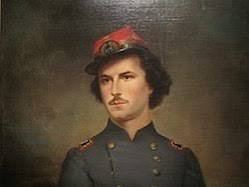
Before Gettysburg, before Antietam or Shiloh, there was Elmer Ellsworth.
He wasn’t a general. He didn’t command thousands. But he was the first Union officer to die in the Civil War, and his death hit the North hard.
Ellsworth was only 24. He grew up in upstate New York and eventually made his way to Illinois, where he studied law and became close friends with Abraham Lincoln. When Lincoln was elected president, Ellsworth followed him to Washington. He wasn’t just a friend. He was someone Lincoln truly trusted.
Ellsworth had a thing for uniforms and precision. He organized the Chicago Zouave Cadets, a flashy militia unit known for their showy drills and strict discipline. When war broke out, he raised a regiment from New York City firefighters called the 11th New York Volunteer Infantry. People called them the Fire Zouaves. They were rough, loud, and fiercely loyal to Ellsworth.
On May 24, 1861, just a day after Virginia officially joined the Confederacy, Union troops crossed the Potomac and entered Alexandria. From Washington, a huge Confederate flag could be seen flying over the Marshall House Inn. Lincoln had probably looked at it from the White House. Ellsworth decided he was going to take it down himself.
He and a small group of men went into the inn. They climbed to the roof, cut down the flag, and started making their way back down. As Ellsworth stepped onto a staircase holding the flag, the innkeeper, James Jackson, appeared with a shotgun. He shot Ellsworth in the chest and killed him instantly. One of Ellsworth’s men shot Jackson in return.
Just like that, the first blood had been drawn.
Ellsworth’s body was taken back to Washington and laid in state in the White House. Lincoln was crushed. He wrote to Ellsworth’s parents, saying their son’s death was one of the most painful events of his life.
All across the North, Ellsworth became a symbol. His face was printed on posters and memorial cards. Some Union regiments even carried flags that said “Remember Ellsworth.” His story was a rallying cry for early volunteers who saw him as a martyr for the cause.
He didn’t die in a big battle. He didn’t go down leading a charge. But Ellsworth’s death showed the country that the war was real, and that even the brightest and best could be taken in an instant.
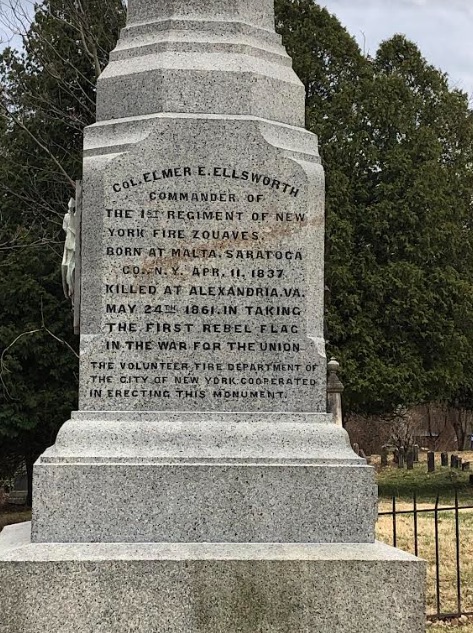
He’s buried in Mechanicville, New York. People still leave flags on his grave.
Today we remember him. Not just because he was the first to fall, but because he believed in something bigger than himself.
Sources:
Library of Congress. “Colonel Elmer E. Ellsworth.” Prints & Photographs Division. https://www.loc.gov/item/2003653537/
National Park Service. “Elmer Ellsworth: Lincoln’s Friend, the Union’s First Martyr.” https://www.nps.gov/people/elmer-ellsworth.htm
Smithsonian Magazine. “The Death of Colonel Elmer Ellsworth.” https://www.smithsonianmag.com/history/the-death-of-colonel-elmer-ellsworth-109492196/
National Archives. “Letter from President Lincoln to the Parents of Colonel Ellsworth, 1861.” https://www.archives.gov/exhibits/american_originals/ellswort.html

Leave a comment